



















SEC Releases
SEC Announces Agenda for June 22 Investor Advisory Committee Meeting
The Securities and Exchange Commission today announced the agenda for the June 22 meeting of its Investor Advisory Committee. The meeting will begin at 10:00 a.m. in the Multipurpose Room at SEC headquarters at 100 F Street, N.E., Washington, D.C. and is open to the public. The meeting will be webcast live and archived on the committee’s website for later viewing.
The committee will hold a discussion in the morning on capital formation for smaller companies and the declining number of initial public offerings. An afternoon session will feature an overview of certain provisions of the Financial CHOICE Act of 2017 relating to the SEC. In addition, the committee will nominate and elect members to open officer positions.
The Investor Advisory Committee was established under Section 911 of the Dodd-Frank Act to advise the SEC on regulatory priorities, the regulation of securities products, trading strategies, fee structures, the effectiveness of disclosure, and on initiatives to protect investor interests and to promote investor confidence and the integrity of the securities marketplace. The Dodd-Frank Act authorizes the committee to submit findings and recommendations to the Commission.
Read MoreSEC Names Stephanie Avakian and Steven Peikin as Co-Directors of Enforcement
The Securities and Exchange Commission today announced that Acting Director of the Division of Enforcement Stephanie Avakian and former federal prosecutor Steven Peikin have been named Co-Directors of the Division of Enforcement. The Division of Enforcement is the agency’s largest unit with more than 1,200 investigators, accountants, trial attorneys, and other professionals.
“There is no place for bad actors in our capital markets, particularly those that prey on investors and undermine confidence in our economy,” said Chairman Jay Clayton. “Stephanie and Steve will aggressively police our capital markets and enforce our nation’s securities laws as Co-Directors of the Division of Enforcement. They have each demonstrated market knowledge, impeccable character, and commitment to public service, and I am confident their combined talents and experience will enable them to effectively lead the Division going forward.”
Ms. Avakian was named Acting Director of the SEC’s Division of Enforcement in December 2016 after serving as Deputy Director of the Division since June 2014. Before being named Deputy Director, Ms. Avakian was a partner at Wilmer Cutler Pickering Hale and Dorr LLP, where she served as a vice chair of the firm’s securities practice and represented financial institutions, public companies, boards, and individuals in a broad range of investigations and other matters before the SEC and other agencies.
Ms. Avakian previously worked in the SEC’s Division of Enforcement as a branch chief in the New York Regional Office, and later served as counsel to former SEC Commissioner Paul Carey.
Ms. Avakian received her bachelor’s degree from the College of New Jersey and a law degree from Temple University School of Law, both with high honors.
“I have been extremely impressed by the work of the Division of Enforcement under Stephanie’s leadership, and I am delighted that she will continue to use her judgment and knowledge to lead the Division,” said Chairman Clayton. “She has a first-class legal mind, has the respect of her colleagues in the Washington and regional offices, and, most importantly, is dedicated to the SEC’s mission.”
“I am proud of the work done by staff in the Enforcement Division, and I am honored and excited to continue leading this dedicated group of professionals with Steve,” said Ms. Avakian. “His experience and judgment will be an asset to both the Enforcement Division and the agency.”
From 1996 to 2004, Mr. Peikin served as an Assistant U.S. Attorney in the Southern District of New York. He was Chief of the Office’s Securities and Commodities Fraud Task Force, where he supervised some of the nation’s highest profile prosecutions of accounting fraud, insider trading, market manipulation, and abuses in the foreign exchange market. As a prosecutor, Mr. Peikin also personally investigated and prosecuted a wide variety of securities, commodities, and other investment fraud schemes, as well as other crimes.
Most recently, Mr. Peikin was Managing Partner of Sullivan & Cromwell’s Criminal Defense and Investigations Group. His practice focused on white-collar criminal defense, regulatory enforcement, and internal investigations. Mr. Peikin also is Adjunct Professor of Law at New York University Law School, where he teaches a class on the criminal enforcement of securities and commodities laws.
Mr. Peikin received his bachelor’s degree from Yale University and a law degree from Harvard Law School, both magna cum laude.
“Steve brings to the SEC deep market knowledge and extensive prosecutorial experience, including in multinational matters,” said Chairman Clayton. “I have no doubt that investors and our markets will benefit from his service.”
“The Division of Enforcement is critical to the SEC’s ability to fulfill its mission of protecting investors and maintaining market integrity. I am honored to join its ranks of dedicated and talented professionals,” said Mr. Peikin. “I look forward to working closely with Stephanie, who is a respected and proven leader.”
Ms. Avakian will continue to work out of the SEC’s Washington, D.C. headquarters. Mr. Peikin will split his time between the SEC’s headquarters and the agency’s New York Regional Office.
Read MoreFee Rate Advisory #3 for Fiscal Year 2017
The Securities and Exchange Commission today announced that starting on July 4, 2017, the fee rates applicable to most securities transactions will be set at $23.10 per million dollars.
Consequently, each SRO will continue to pay the Commission a rate of $21.80 per million for covered sales occurring on charge dates through July 3, 2017, and a rate of $23.10 per million for covered sales occurring on charge dates on or after July 4, 2017.
For more information on the term “charge date,” please refer to Rule 31(a)(3) and Exchange Act Release No. 49928 at http://www.sec.gov/rules/final/34-49928.htm.
The assessment on security futures transactions will remain unchanged at $0.0042 for each round turn transaction.
The Commission determined these new rates in accordance with Section 31 of the Securities Exchange Act of 1934. These adjustments do not directly affect the amount of funding available to the SEC.
The Office of Interpretation and Guidance in the Commission’s Division of Trading and Markets is available for questions on Section 31 at (202) 551-5777 or by e-mail at tradingandmarkets@sec.gov.
The Commission will issue further notices as appropriate to keep the public informed of developments relating to fees under Section 31. These notices will be posted on the SEC website.
Read MoreSEC Names Peter Uhlmann Managing Executive in Chairman’s Office
The Securities and Exchange Commission today announced that Peter Uhlmann has been named the managing executive in the Office of Chairman Jay Clayton. Mr. Uhlmann will advise Chairman Clayton in matters relating to agency administration, operations, and management, and will serve as the Chairman’s primary liaison to divisions and offices on these matters.
“I am pleased that Pete has taken on the managing executive role and that I will be able to draw on his experience, judgment, and knowledge of the agency. It is clear that Pete is a dedicated professional committed to ensuring the SEC’s continued operational effectiveness and responsiveness,” said Chairman Clayton.
Mr. Uhlmann has served in a variety of senior leadership positions during his tenure at the SEC. Most recently, Mr. Uhlmann served as managing executive for then-Acting Chairman Michael S. Piwowar. Prior to that, he was managing executive of the SEC’s Division of Corporation Finance, where he oversaw the internal business operations that support the division’s personnel. He has also worked as a senior advisor to the executive director, where he led initiatives to assess and improve the effectiveness of SEC operations.
Mr. Uhlmann also served at the SEC as chief of staff and senior advisor to former Chairman Christopher Cox.
Mr. Uhlmann is a graduate of Yale University.
Read MoreSEC Names Peter Uhlmann Managing Executive in Chairman’s Office
The Securities and Exchange Commission today announced that Peter Uhlmann has been named the managing executive in the Office of Chairman Jay Clayton. Mr. Uhlmann will advise Chairman Clayton in matters relating to agency administration, operations, and management, and will serve as the Chairman’s primary liaison to divisions and offices on these matters.
“I am pleased that Pete has taken on the managing executive role and that I will be able to draw on his experience, judgment, and knowledge of the agency. It is clear that Pete is a dedicated professional committed to ensuring the SEC’s continued operational effectiveness and responsiveness,” said Chairman Clayton.
Mr. Uhlmann has served in a variety of senior leadership positions during his tenure at the SEC. Most recently, Mr. Uhlmann served as managing executive for then-Acting Chairman Michael S. Piwowar. Prior to that, he was managing executive of the SEC’s Division of Corporation Finance, where he oversaw the internal business operations that support the division’s personnel. He has also worked as a senior advisor to the executive director, where he led initiatives to assess and improve the effectiveness of SEC operations.
Mr. Uhlmann also served at the SEC as chief of staff and senior advisor to former Chairman Christopher Cox.
Mr. Uhlmann is a graduate of Yale University.
Read MoreSEC Files Charges in Trading Scheme Involving Confidential Government Information
The Securities and Exchange Commission today announced charges in an alleged insider trading scheme involving tips of nonpublic information about government plans to cut Medicare reimbursement rates, which affected the stock prices of certain publicly traded medical providers or suppliers.
The SEC’s complaint alleges that David Blaszczak, a former government employee turned political intelligence consultant, obtained key confidential details about upcoming decisions by the Centers for Medicare and Medicaid Services (CMS) from his close friend and former colleague at the agency, Christopher Worrall. According to the SEC’s complaint, Worrall serves as a health insurance specialist in the Center for Medicare and tipped Blaszczak about at least three pending CMS decisions that affected the amount of money that companies receive from Medicare to provide services or products related to cancer treatments or kidney dialysis.
Blaszczak allegedly tipped two analysts at a hedge fund advisory firm that paid him as a consultant. The analysts, Theodore Huber and Jordan Fogel, allegedly used the nonpublic information to recommend that the firm trade in the stocks of four health care companies whose stock prices would likely be affected by the decisions once CMS announced them publicly. The alleged scheme resulted in more than $3.9 million in illicit profits.
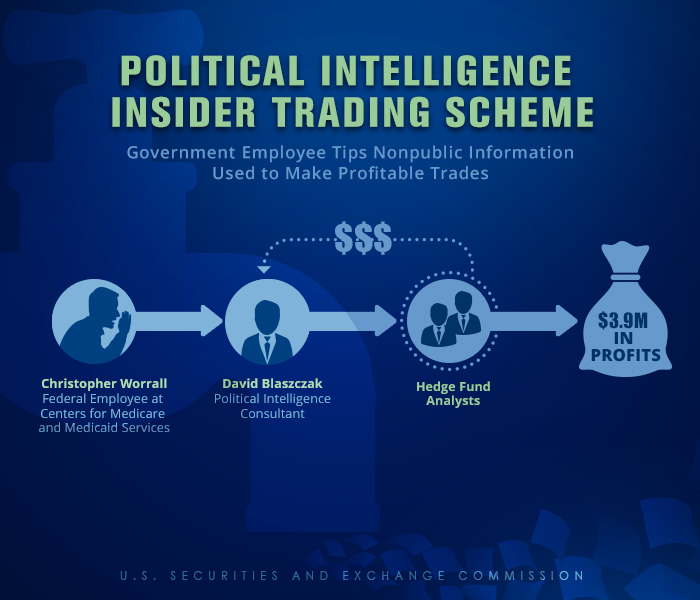
“As alleged in our complaint, a federal employee breached his duty to protect confidential information by tipping a political consultant who then passed along those illegal tips,” said Stephanie Avakian, Acting Director of the SEC Enforcement Division. “There’s no place on Wall Street or in our government for such blatant misuse of highly confidential information.”
According to the SEC’s complaint, Blaszczak’s firms were paid at least $193,000 in a 19-month period by the hedge fund where the analysts worked.
“We remain committed to using all resources available to detect sophisticated schemes and stop those who try to create a revenue stream by tipping or trading on material, nonpublic information,” said Robert A. Cohen, Co-Chief of the SEC Enforcement Division’s Market Abuse Unit.
The SEC’s complaint, filed in U.S. District Court for the Southern District of New York, charges Blaszczak, Worrall, Huber, and Fogel with violating Section 10(b) of the Securities Exchange Act of 1934 and Rule 10b-5 as well as Section 17(a) of the Securities Act of 1933. The complaint seeks disgorgement of ill-gotten gains plus interest, penalties, and permanent injunctions.
In a parallel action, the U.S. Attorney’s Office for the Southern District of New York today announced related criminal charges.
The SEC’s investigation, which is continuing, has been conducted by Ann Rosenfield, Patrick McCluskey, and Carolyn Welshhans in the Market Abuse Unit. The case has been supervised by Mr. Cohen. The litigation will be led by Gregory Bockin and A. Kristina Littman and supervised by Cheryl Crumpton. The SEC appreciates the assistance of the U.S. Attorney’s Office for the Southern District of New York, the Federal Bureau of Investigation, and the Department of Health and Human Services Office of Inspector General.
Read MoreSEC and MSRB to Hold Webinar on Series 50 Exam for Municipal Advisors
The Securities and Exchange Commission (SEC) and the Municipal Securities Rulemaking Board (MSRB) today announced a joint educational webinar to assist municipal advisors with understanding their professional qualification requirements. The live webinar, scheduled for Thursday, June 15, 2017, from 3-4 p.m. ET, will provide information on signing up for the MSRB’s Municipal Advisor Representative Qualification Examination (Series 50 exam), preparing to take the Series 50 exam, and fulfilling municipal advisor firms’ SEC registration obligations.
“Providing and maintaining accurate and up-to-date information on municipal advisor firms’ initial registration forms and subsequent amendments is essential to ensuring the effectiveness of the municipal advisor registration system,” said Jessica Kane, Director of the SEC’s Office of Municipal Securities. “In particular, information about associated persons on Form MA-I promotes confidence in the municipal advisor registration regime and helps protect municipal entities, obligated persons, the public, and, ultimately, investors. The Office of Municipal Securities is pleased to partner with the MSRB on this webinar.”
The MSRB’s recent regulatory notice reminded municipal advisor firms that after Sept. 12, 2017, only associated persons who have passed the Series 50 exam can engage in municipal advisory activity on behalf of the firm.
“We hope that this webinar will address questions municipal advisor firms have about the process for enrolling their associated persons to take the exam by the deadline,” said MSRB Executive Director Lynnette Kelly. “The webinar should be particularly valuable for those firms that do not yet have a single Series 50-qualified municipal advisor representative associated with the firm nor any individual scheduled to sit for the exam.”
The MSRB makes available on its website a list of Series 50-qualified municipal advisor representatives and their associated municipal advisor firms. Qualification information is updated weekly and is dependent on the quality of the data municipal advisor firms submit to the SEC through Form MA-I.
During the free webinar, staff of the SEC and MSRB will review the standards of professional qualification for municipal advisors, discuss the enrollment process for taking the Series 50 exam, and highlight relevant municipal advisor SEC registration obligations. Members of the public interested in viewing the webinar should register here.
Read MoreSEC Charges Fake Filer With Manipulating Fitbit Stock
The Securities and Exchange Commission today filed fraud charges against a Virginia-based mechanical engineer accused of scheming to manipulate the price of Fitbit stock by making a phony regulatory filing.
According to the SEC’s complaint, Robert W. Murray purchased Fitbit call options just minutes before a fake tender offer that he orchestrated was filed on the SEC’s EDGAR system purporting that a company named ABM Capital LTD sought to acquire Fitbit’s outstanding shares at a substantial premium. Fitbit’s stock price temporarily spiked when the tender offer became publicly available on Nov. 10, 2016, and Murray sold all of his options for a profit of approximately $3,100.
The SEC alleges that Murray created an email account under the name of someone he found on the internet, and the email account was used to gain access to the EDGAR system. Murray then allegedly listed that person as the CFO of ABM Capital and used a business address associated with that person in the fake filing. The SEC also alleges that Murray attempted to conceal his identity and actual location at the time of the filing after conducting research into prior SEC cases that highlighted the IP addresses the false filers used to submit forms on EDGAR. According to the SEC’s complaint, it appeared as though the system was being accessed from a different state by using an IP address registered to a company located in Napa, California.
“As alleged in our complaint, Murray used deceptive techniques in a concerted effort to evade detection, but we were able to connect the dots quickly and hold him accountable,” said Stephanie Avakian, Acting Director of the SEC Enforcement Division.
In a parallel action, the U.S. Attorney’s Office for the Southern District of New York today announced criminal charges against Murray.
The SEC’s complaint charges Murray with violating antifraud provisions of the federal securities laws, including Section 17(a) of the Securities Act of 1933 and Sections 10(b) and 14(e) of the Securities Exchange Act of 1934, and Rules 10b-5 and 14e-8.
The SEC’s continuing investigation is being conducted by David W. Snyder, Assunta Vivolo, Kelly L. Gibson, and Patrick A. McCluskey in the Market Abuse Unit in Philadelphia. The case is being supervised by unit co-chiefs Robert A. Cohen and Joseph G. Sansone. The litigation will be led by Julia C. Green and Christopher R. Kelly of the Philadelphia office. The SEC appreciates the assistance of the U.S. Attorney’s Office for the Southern District of New York and the U.S. Postal Inspection Service.
Read MoreDavid Peavler, Associate Director of Enforcement in Fort Worth Office, to Leave SEC
The Securities and Exchange Commission today announced that David L. Peavler, Associate Director of Enforcement in the Fort Worth Regional Office, is leaving the agency this month after more than 15 years of service.
Mr. Peavler joined the SEC staff as a Staff Attorney and went on to serve as a Branch Chief and then an Assistant Director before being named Associate Director in November 2011. Mr. Peavler has supervised a staff of more than 60 attorneys and other professionals responsible for investigating potential violations of the federal securities laws by a wide range of market participants.
Mr. Peavler received the SEC’s Irving Pollack Award last year in recognition of his “fairness and compassion in dealings with the public and staff, scholarship and professional expertise in execution of their legal duties, and adherence to the highest standards of personal and professional integrity.” He received the agency’s Arthur F. Mathews Award in 2004 for “sustained demonstrated creativity in applying federal securities laws for the benefit of investors.”
Stephanie Avakian, Acting Director of the SEC’s Enforcement Division, said, “David is an exceptional attorney and a dedicated public servant who has led and supervised an array of complex and high-impact actions. He has demonstrated time and time again his commitment to protecting investors and our markets.”
Shamoil T. Shipchandler, Director of the SEC’s Fort Worth Regional Office, added, “David’s consistency, creativity, professionalism, and integrity are unparalleled, and he has led not only by word but by example. His leadership of Fort Worth’s enforcement program will be emulated but never duplicated.”
Mr. Peavler said, “I’m fortunate to have served with so many skilled and dedicated people. Their untiring commitment to investor protection has truly been inspirational, and I’m proud of our achievements.”
Among the enforcement actions taken by the SEC’s Fort Worth office under Mr. Peavler’s leadership:
- Seaboard Corporation, in which the SEC first set forth its corporate cooperation guidance.
- Royal Dutch Shell, which paid $120 million to settle fraud charges arising from its 4.5 billion barrel proved reserves misstatement.
- i2 Technologies and three of its former senior officers, who collectively paid more than $20 million to settle fraud charges relating to a billion dollar software revenue overstatement.
- The former CEO and CFO of Quest Resources Corporation, who were charged with misappropriating millions of dollars through undisclosed insider loans.
- Millennium Bank and its founder, who operated a $100 million international Ponzi scheme.
- Life Partners Holdings and its former senior officers, who a jury found liable for fraud in connection with disclosures and accounting for life settlements. They were ordered to pay millions of dollars in penalties.
- KBR Inc. and SandRidge Energy, which each settled allegations arising from their use of improper non-disclosure agreements that inhibited employees from reporting fraud and misconduct to the SEC.
Mr. Peavler received his undergraduate degree in accounting and economics from Baylor University in 1989 and his law degree from the University of Texas in 1992.
Read MoreSEC Names Robert B. Stebbins as General Counsel
The Securities and Exchange Commission today announced that Robert B. Stebbins has been named General Counsel of the agency.
The General Counsel is the chief legal officer of the agency, providing a variety of legal services to the Commission and staff.
“Bob is an exceptional attorney and counselor, and I know his depth of knowledge and experience managing a wide range of securities-related issues will benefit the SEC,” said Chairman Jay Clayton. “I thank Bob for his commitment to serving his country and our agency, and I look forward to his steadfast guidance as the Commission’s chief legal officer.”
“I have always had a great deal of respect for the SEC’s staff and their commitment to the agency’s core mission, and I am proud to be part of the team,” said Mr. Stebbins. “I look forward to sharing my experience with this talented group of professionals, and I am grateful for this tremendous opportunity.”
Mr. Stebbins has practiced law at Willkie Farr & Gallagher LLP since 1993, first as an associate and beginning in 2001 as a partner. At Willkie, Mr. Stebbins focused on mergers and acquisitions, private equity and venture capital, investment funds, and capital markets transactions. He also advised clients on SEC compliance issues and corporate governance matters.
Mr. Stebbins earned a J.D. from the University of Pennsylvania and a B.S. from Central Michigan University, where he was an Academic All-American football player. He is a member of the American Bar Association and the New York City Bar Association and is a fellow of the American College of Investment Counsel.
Read MoreSEC Names Jaime Klima Chief Counsel
The Securities and Exchange Commission today announced that Jaime Klima has been named Chief Counsel to Chairman Jay Clayton.
As Chief Counsel, Ms. Klima will be senior legal and policy adviser, and will coordinate the rulemaking agenda of the Commission. She will also serve as the Chairman’s representative on the Deputies Committee of the Financial Stability Oversight Council.
“I am thrilled that Jaime has agreed to serve the Commission in this key role,” said Chairman Jay Clayton. “I am pleased that Jaime’s legal acumen and experience will continue to benefit the SEC and its team of committed professionals.”
Most recently, Ms. Klima served as SEC co-chief of staff under then-Acting Chairman Michael S. Piwowar, advising on all issues of agency management and policy. Before that, she was counsel to Commissioner Piwowar and Commissioner Troy A. Paredes. In those roles, Ms. Klima covered a wide range of issues including rulemaking and enforcement matters.
Prior to working at the SEC, Ms. Klima practiced law at Wilmer Cutler Pickering Hale and Dorr LLP, specializing in broker-dealer compliance and regulation. She also clerked for the Honorable Richard Lowell Nygaard of the U.S. Court of Appeals for the Third Circuit.
Ms. Klima earned her J.D., cum laude, from Duke University School of Law, a Master of Public Policy, also from Duke, and an undergraduate degree in Systems Engineering, with distinction, from the University of Virginia.
Read MoreSEC Names Sean Memon Deputy Chief of Staff
The Securities and Exchange Commission today announced that Sean Memon has been named the agency’s deputy chief of staff.
“Sean has proven to have extensive knowledge of financial regulation and coordination across our various markets. I commend his willingness to share his expertise here at the SEC as we further the agency’s important mission,” said Chairman Jay Clayton.
Mr. Memon arrived at the SEC with experience providing advice to public and private companies in both legal and financial roles. Immediately prior to joining the SEC, Mr. Memon practiced law at Sullivan & Cromwell LLP in Washington, D.C., where he advised clients in regulatory and transactional matters, including with respect to capital raisings, mergers and acquisitions and joint ventures. Mr. Memon also advised companies on matters involving financial technology and the development of new products and services.
Previously, Mr. Memon was a member of the Finance and Acquisitions department at Time Warner Inc., where he worked on long-term business planning efforts and performed quantitative valuation and financial impact analysis for potential new business initiatives and transactions. Prior to Time Warner, Mr. Memon was an analyst in the investment banking groups of Raymond James & Associates and Morgan Stanley & Co., where he worked with technology companies on capital raising activities and mergers and acquisitions.
Mr. Memon received J.D. and MBA degrees from Duke University and an A.B. in economics from Harvard College.
Read More