



















Blog
Executives Charged With Manipulating Company’s Accounting Systems to Steal Money
The Securities and Exchange Commission today charged two former executives at a credit card processing company with masterminding a fraudulent scheme to steal millions of dollars through phony expense reimbursements, inflated invoices, and other improper accounting tactics.
The SEC’s complaint alleges that iPayment’s then-senior vice president of sales and marketing Nasir N. Shakouri and then-executive vice president and chief operating officer Robert S. Torino routinely reimbursed themselves for payments that were never actually made to third-party vendors using their personal credit cards. They also allegedly conspired with vendors to inflate invoices and receive kickbacks from the overpayments, and claimed improper commissions and bonuses related to other corporate funds they improperly diverted in various ways.
The SEC’s complaint also charges three other iPayment executives – Bronson L. Quon, John S. Hong, and Jonathan K. Skarie – with participating in the scheme and helping Shakouri and Torino falsify books and records to hide the thefts of corporate funds. Quon, Hong, and Skarie were allegedly rewarded for their assistance with misappropriated iPayment funds.
“As alleged in our complaint, these executives manipulated iPayment’s internal accounting systems, lied to the external auditor, and caused approximately $11.6 million in losses to the company,” said Sanjay Wadhwa, Senior Associate Director of the SEC’s New York Regional Office.
In a parallel action, the U.S. Attorney’s Office for the Central District of California today announced criminal charges against Shakouri and Torino.
The SEC is seeking disgorgement of ill-gotten gains plus interest and penalties as well as officer-and-director bars.
The SEC’s investigation has been conducted by Kristin M. Pauley, Melissa A. Coppola, Maureen P. King, Roseann Daniello, Diego Brucculeri, Richard Hong, Nicholas Pilgrim, Scott B. York, and Valerie A. Szczepanik in the New York office. The litigation will be led by Mr. Hong and Ms. Pauley along with John Bulgozdy, who works in the Los Angeles office. The case is being supervised by Mr. Wadhwa. The SEC appreciates the assistance of the U.S. Attorney’s Office for the Central District of California, the Federal Bureau of Investigation, and the Internal Revenue Service.
Read MoreExecutives Charged With Manipulating Company’s Accounting Systems to Steal Money
The Securities and Exchange Commission today charged two former executives at a credit card processing company with masterminding a fraudulent scheme to steal millions of dollars through phony expense reimbursements, inflated invoices, and other improper accounting tactics.
The SEC’s complaint alleges that iPayment’s then-senior vice president of sales and marketing Nasir N. Shakouri and then-executive vice president and chief operating officer Robert S. Torino routinely reimbursed themselves for payments that were never actually made to third-party vendors using their personal credit cards. They also allegedly conspired with vendors to inflate invoices and receive kickbacks from the overpayments, and claimed improper commissions and bonuses related to other corporate funds they improperly diverted in various ways.
The SEC’s complaint also charges three other iPayment executives – Bronson L. Quon, John S. Hong, and Jonathan K. Skarie – with participating in the scheme and helping Shakouri and Torino falsify books and records to hide the thefts of corporate funds. Quon, Hong, and Skarie were allegedly rewarded for their assistance with misappropriated iPayment funds.
“As alleged in our complaint, these executives manipulated iPayment’s internal accounting systems, lied to the external auditor, and caused approximately $11.6 million in losses to the company,” said Sanjay Wadhwa, Senior Associate Director of the SEC’s New York Regional Office.
In a parallel action, the U.S. Attorney’s Office for the Central District of California today announced criminal charges against Shakouri and Torino.
The SEC is seeking disgorgement of ill-gotten gains plus interest and penalties as well as officer-and-director bars.
The SEC’s investigation has been conducted by Kristin M. Pauley, Melissa A. Coppola, Maureen P. King, Roseann Daniello, Diego Brucculeri, Richard Hong, Nicholas Pilgrim, Scott B. York, and Valerie A. Szczepanik in the New York office. The litigation will be led by Mr. Hong and Ms. Pauley along with John Bulgozdy, who works in the Los Angeles office. The case is being supervised by Mr. Wadhwa. The SEC appreciates the assistance of the U.S. Attorney’s Office for the Central District of California, the Federal Bureau of Investigation, and the Internal Revenue Service.
Read MoreSEC Charges Firms Involved in Layering, Manipulation Schemes
The Securities and Exchange Commission today announced fraud charges against a Ukraine-based trading firm accused of manipulating the U.S. markets hundreds of thousands of times and the New York-based brokerage firm and CEO who allegedly helped make it possible.
The SEC’s complaint alleges that Avalon FA Ltd touted itself to traders as a destination to engage in layering, a scheme in which orders are placed but later canceled after tricking others into buying or selling stocks at artificial prices, resulting in illicit profits. Avalon allegedly made more than $21 million in the layering scheme involving U.S. stocks during a five-year period. According to the SEC’s complaint, Avalon also made more than $7 million in illicit profits through a cross-market manipulation scheme in which the firm bought and sold U.S. stocks at a loss in order to manipulate the prices of the stock and its corresponding options so that it could then profitably trade at artificial prices. Avalon allegedly used traders in Eastern Europe and Asia to conduct its trading, and the firm kept a portion of the profits and collected commissions from the traders.
The SEC’s complaint also describes fraud charges against Avalon’s named owner Nathan Fayyer and Sergey Pustelnik, who allegedly kept his controlling interest in Avalon undisclosed and embedded himself at Lek Securities as a registered representative, using his position to facilitate the schemes.
The SEC further alleges that Lek Securities and its owner Samuel Lek made the schemes possible by providing Avalon with access to the U.S. markets, approving the cross-market trading scheme, and improving its trading technology to assist Avalon’s trading. According to the SEC’s complaint, Lek Securities also relaxed its layering controls after Avalon complained. Avalon was the highest-producing customer for Lek Securities in terms of trading commissions, fees, and rebates generated.
“As alleged in our complaint, Avalon openly marketed itself as a destination for manipulative trading, and Lek Securities opened the gate to allow the schemes into the U.S. markets despite repeated warnings that its customer was manipulating the market,” said Stephanie Avakian, Acting Director of the SEC’s Division of Enforcement.
After filing its complaint in U.S. District Court for the Southern District of New York, the SEC obtained an emergency court order freezing Avalon’s assets held in its account at Lek Securities as well as freezing and repatriating funds that Avalon has transferred overseas.
The SEC’s investigation was conducted by Sarah S. Nilson along with Owen A. Granke and Carolyn Welshhans of the Market Abuse Unit. The case was supervised by Melissa Hodgman, Antonia Chion, and Robert A. Cohen. The litigation will be led by David J. Gottesman, Olivia S. Choe, and Ms. Nilson. The SEC appreciates the assistance of the Financial Industry Regulatory Authority.
Read MoreSEC Charges Firms Involved in Layering, Manipulation Schemes
The Securities and Exchange Commission today announced fraud charges against a Ukraine-based trading firm accused of manipulating the U.S. markets hundreds of thousands of times and the New York-based brokerage firm and CEO who allegedly helped make it possible.
The SEC’s complaint alleges that Avalon FA Ltd touted itself to traders as a destination to engage in layering, a scheme in which orders are placed but later canceled after tricking others into buying or selling stocks at artificial prices, resulting in illicit profits. Avalon allegedly made more than $21 million in the layering scheme involving U.S. stocks during a five-year period. According to the SEC’s complaint, Avalon also made more than $7 million in illicit profits through a cross-market manipulation scheme in which the firm bought and sold U.S. stocks at a loss in order to manipulate the prices of the stock and its corresponding options so that it could then profitably trade at artificial prices. Avalon allegedly used traders in Eastern Europe and Asia to conduct its trading, and the firm kept a portion of the profits and collected commissions from the traders.
The SEC’s complaint also describes fraud charges against Avalon’s named owner Nathan Fayyer and Sergey Pustelnik, who allegedly kept his controlling interest in Avalon undisclosed and embedded himself at Lek Securities as a registered representative, using his position to facilitate the schemes.
The SEC further alleges that Lek Securities and its owner Samuel Lek made the schemes possible by providing Avalon with access to the U.S. markets, approving the cross-market trading scheme, and improving its trading technology to assist Avalon’s trading. According to the SEC’s complaint, Lek Securities also relaxed its layering controls after Avalon complained. Avalon was the highest-producing customer for Lek Securities in terms of trading commissions, fees, and rebates generated.
“As alleged in our complaint, Avalon openly marketed itself as a destination for manipulative trading, and Lek Securities opened the gate to allow the schemes into the U.S. markets despite repeated warnings that its customer was manipulating the market,” said Stephanie Avakian, Acting Director of the SEC’s Division of Enforcement.
After filing its complaint in U.S. District Court for the Southern District of New York, the SEC obtained an emergency court order freezing Avalon’s assets held in its account at Lek Securities as well as freezing and repatriating funds that Avalon has transferred overseas.
The SEC’s investigation was conducted by Sarah S. Nilson along with Owen A. Granke and Carolyn Welshhans of the Market Abuse Unit. The case was supervised by Melissa Hodgman, Antonia Chion, and Robert A. Cohen. The litigation will be led by David J. Gottesman, Olivia S. Choe, and Ms. Nilson. The SEC appreciates the assistance of the Financial Industry Regulatory Authority.
Read MoreSEC Charges Marijuana-Related Company and Executives With Touting Bogus Revenues
The Securities and Exchange Commission today charged a California-based company and its founder with falsely touting “record” revenue numbers to investors and claiming to be a leader in the marijuana industry while some of its earnings came from sham transactions with a secret affiliate.
According to the SEC’s complaint, Medbox provided marijuana consulting services and claimed to sell vending machines known as “Medbox” devices capable of dispensing marijuana on the basis of biometric identification. The SEC alleges that Vincent Mehdizadeh created a shell company called New-Age Investment Consulting to carry out illegal stock sales and used the proceeds from those sales to boost Medbox’s revenue. Medbox allegedly issued press releases headlining the phony revenues as record earnings to legitimize itself as a viable commercial operation when in fact nearly 90 percent of the company’s revenue in the first quarter of 2014 stemmed from sham transactions with New-Age. Mehdizadeh allegedly acknowledged in a text message that “the only thing we are really good at is public company publicity and stock awareness. We get an A+ for creating revenue off sheer will but that won’t continue.”
Meanwhile, according to the SEC’s complaint, Mehdizadeh funded the purchase of a luxury home in the Pacific Palisades with proceeds from New-Age’s illicit stock sales.
The SEC’s complaint additionally charges Medbox’s then-CEO Bruce Bedrick with being complicit in the scheme and personally profiting. The SEC also charged New-Age and Mehdizadeh’s then-fiancée Yocelin Legaspi with unlawfully selling unregistered securities. Mehdizadeh installed Legaspi as the supposed CEO of New-Age when he created the company.
“As alleged in our complaint, investors were misled into believing that Medbox was a leader in the burgeoning marijuana industry when the company was just round-tripping money from illegal stock sales to boost revenue,” said Michele Wein Layne, Director of the SEC’s Los Angeles Regional Office.
Mehdizadeh and Medbox, which has since changed its name to Notis Global, have agreed to settle the SEC’s charges. Mehdizadeh agreed to pay more than $12 million in disgorgement and penalties and agreed to be barred from serving as an officer or director of a public company or participating in any penny stock offerings. The settlements are subject to court approval. The SEC’s litigation continues against Bedrick, Legaspi, and New-Age.
The SEC’s investigation was conducted by Megan M. Bergstrom, Roger Boudreau, and Spencer Bendell of the Los Angeles office. The litigation will be led by Gary Leung. The SEC appreciates the assistance of the Financial Industry Regulatory Authority.
Read MoreSEC Charges Marijuana-Related Company and Executives With Touting Bogus Revenues
The Securities and Exchange Commission today charged a California-based company and its founder with falsely touting “record” revenue numbers to investors and claiming to be a leader in the marijuana industry while some of its earnings came from sham transactions with a secret affiliate.
According to the SEC’s complaint, Medbox provided marijuana consulting services and claimed to sell vending machines known as “Medbox” devices capable of dispensing marijuana on the basis of biometric identification. The SEC alleges that Vincent Mehdizadeh created a shell company called New-Age Investment Consulting to carry out illegal stock sales and used the proceeds from those sales to boost Medbox’s revenue. Medbox allegedly issued press releases headlining the phony revenues as record earnings to legitimize itself as a viable commercial operation when in fact nearly 90 percent of the company’s revenue in the first quarter of 2014 stemmed from sham transactions with New-Age. Mehdizadeh allegedly acknowledged in a text message that “the only thing we are really good at is public company publicity and stock awareness. We get an A+ for creating revenue off sheer will but that won’t continue.”
Meanwhile, according to the SEC’s complaint, Mehdizadeh funded the purchase of a luxury home in the Pacific Palisades with proceeds from New-Age’s illicit stock sales.
The SEC’s complaint additionally charges Medbox’s then-CEO Bruce Bedrick with being complicit in the scheme and personally profiting. The SEC also charged New-Age and Mehdizadeh’s then-fiancée Yocelin Legaspi with unlawfully selling unregistered securities. Mehdizadeh installed Legaspi as the supposed CEO of New-Age when he created the company.
“As alleged in our complaint, investors were misled into believing that Medbox was a leader in the burgeoning marijuana industry when the company was just round-tripping money from illegal stock sales to boost revenue,” said Michele Wein Layne, Director of the SEC’s Los Angeles Regional Office.
Mehdizadeh and Medbox, which has since changed its name to Notis Global, have agreed to settle the SEC’s charges. Mehdizadeh agreed to pay more than $12 million in disgorgement and penalties and agreed to be barred from serving as an officer or director of a public company or participating in any penny stock offerings. The settlements are subject to court approval. The SEC’s litigation continues against Bedrick, Legaspi, and New-Age.
The SEC’s investigation was conducted by Megan M. Bergstrom, Roger Boudreau, and Spencer Bendell of the Los Angeles office. The litigation will be led by Gary Leung. The SEC appreciates the assistance of the Financial Industry Regulatory Authority.
Read MoreSEC Charges Marijuana-Related Company and Executives With Touting Bogus Revenues
The Securities and Exchange Commission today charged a California-based company and its founder with falsely touting “record” revenue numbers to investors and claiming to be a leader in the marijuana industry while some of its earnings came from sham transactions with a secret affiliate.
According to the SEC’s complaint, Medbox provided marijuana consulting services and claimed to sell vending machines known as “Medbox” devices capable of dispensing marijuana on the basis of biometric identification. The SEC alleges that Vincent Mehdizadeh created a shell company called New-Age Investment Consulting to carry out illegal stock sales and used the proceeds from those sales to boost Medbox’s revenue. Medbox allegedly issued press releases headlining the phony revenues as record earnings to legitimize itself as a viable commercial operation when in fact nearly 90 percent of the company’s revenue in the first quarter of 2014 stemmed from sham transactions with New-Age. Mehdizadeh allegedly acknowledged in a text message that “the only thing we are really good at is public company publicity and stock awareness. We get an A+ for creating revenue off sheer will but that won’t continue.”
Meanwhile, according to the SEC’s complaint, Mehdizadeh funded the purchase of a luxury home in the Pacific Palisades with proceeds from New-Age’s illicit stock sales.
The SEC’s complaint additionally charges Medbox’s then-CEO Bruce Bedrick with being complicit in the scheme and personally profiting. The SEC also charged New-Age and Mehdizadeh’s then-fiancée Yocelin Legaspi with unlawfully selling unregistered securities. Mehdizadeh installed Legaspi as the supposed CEO of New-Age when he created the company.
“As alleged in our complaint, investors were misled into believing that Medbox was a leader in the burgeoning marijuana industry when the company was just round-tripping money from illegal stock sales to boost revenue,” said Michele Wein Layne, Director of the SEC’s Los Angeles Regional Office.
Mehdizadeh and Medbox, which has since changed its name to Notis Global, have agreed to settle the SEC’s charges. Mehdizadeh agreed to pay more than $12 million in disgorgement and penalties and agreed to be barred from serving as an officer or director of a public company or participating in any penny stock offerings. The settlements are subject to court approval. The SEC’s litigation continues against Bedrick, Legaspi, and New-Age.
The SEC’s investigation was conducted by Megan M. Bergstrom, Roger Boudreau, and Spencer Bendell of the Los Angeles office. The litigation will be led by Gary Leung. The SEC appreciates the assistance of the Financial Industry Regulatory Authority.
Read MoreSEC Economist Receives Award for Academic Work on Market Insights
Securities and Exchange Commission economist Dr. Giulio Girardi today received the CFA Institute Financial Analysts Journal®’s Graham and Dodd Top Award for 2016. Dr. Girardi is a Branch Chief in the SEC’s Division of Economic and Risk Analysis’s (DERA) Office of Risk Assessment.
Dr. Girardi’s award-winning paper, “Interconnectedness in the CDS Market,” helps assess the stability of the credit default swap market and potential contagion among market participants. He co-authored the paper with former SEC Chief Economist Craig Lewis and former DERA visiting scholar Mila Sherman. Past recipients of the Graham and Dodd Award include numerous distinguished economists, including Nobel laureates.
“On behalf of the SEC, and as a fellow economist, it is my pleasure to congratulate Dr. Giulio Girardi and his co-authors on receiving The Financial Analyst Journal’s Graham and Dodd Top Award,” said SEC Acting Chairman Michael Piwowar. “His research and analysis on the potential for systemic risk in the credit default swap market has provided the public with valuable insights and is a testament to the high quality of economic research that our staff produces to advance the SEC’s mission.”
“I am happy to congratulate my colleague Dr. Girardi as his name is added to a distinguished list that includes Nobel laureates and other luminaries in the finance profession,” said SEC Acting Chief Economist Scott Bauguess. “Dr. Girardi’s award is an excellent example of how DERA, through its tremendous growth and maturation since the financial crisis, has been able to recruit and retain some of the brightest minds in the profession.”
About the SEC’s Division of Economic and Risk Analysis
DERA was created in September 2009 to integrate financial economics and rigorous data analytics into the core mission of the SEC. The division is involved across the entire range of SEC activities, including policy-making, rulemaking, enforcement, and examination. As the agency’s “think tank,” DERA relies on a variety of academic disciplines, quantitative and non-quantitative approaches, and knowledge of market institutions and practices to help the Commission approach complex matters in a fresh light. DERA also assists in the Commission’s efforts to identify, analyze, and respond to risks and trends, including those associated with new financial products and strategies. Through the range and nature of its activities, DERA serves the critical function of promoting collaborative efforts throughout the agency and breaking through silos that might otherwise limit the impact of the agency’s institutional expertise. More information is available here.
About the Graham and Dodd Award (from The Financial Analyst Journal’s website)
The Graham and Dodd Awards were created in 1960 to recognize excellence in research and financial writing and to honor Benjamin Graham and David L. Dodd for their enduring contributions to the field of investment analysis. More information is available here.
The U.S. Securities and Exchange Commission does not endorse the web site, its sponsor, or any of the policies, activities, products, or services offered on the site or by any advertiser on the site.
Read MoreSEC Economist Receives Award for Academic Work on Market Insights
Securities and Exchange Commission economist Dr. Giulio Girardi today received the CFA Institute Financial Analysts Journal®’s Graham and Dodd Top Award for 2016. Dr. Girardi is a Branch Chief in the SEC’s Division of Economic and Risk Analysis’s (DERA) Office of Risk Assessment.
Dr. Girardi’s award-winning paper, “Interconnectedness in the CDS Market,” helps assess the stability of the credit default swap market and potential contagion among market participants. He co-authored the paper with former SEC Chief Economist Craig Lewis and former DERA visiting scholar Mila Sherman. Past recipients of the Graham and Dodd Award include numerous distinguished economists, including Nobel laureates.
“On behalf of the SEC, and as a fellow economist, it is my pleasure to congratulate Dr. Giulio Girardi and his co-authors on receiving The Financial Analyst Journal’s Graham and Dodd Top Award,” said SEC Acting Chairman Michael Piwowar. “His research and analysis on the potential for systemic risk in the credit default swap market has provided the public with valuable insights and is a testament to the high quality of economic research that our staff produces to advance the SEC’s mission.”
“I am happy to congratulate my colleague Dr. Girardi as his name is added to a distinguished list that includes Nobel laureates and other luminaries in the finance profession,” said SEC Acting Chief Economist Scott Bauguess. “Dr. Girardi’s award is an excellent example of how DERA, through its tremendous growth and maturation since the financial crisis, has been able to recruit and retain some of the brightest minds in the profession.”
About the SEC’s Division of Economic and Risk Analysis
DERA was created in September 2009 to integrate financial economics and rigorous data analytics into the core mission of the SEC. The division is involved across the entire range of SEC activities, including policy-making, rulemaking, enforcement, and examination. As the agency’s “think tank,” DERA relies on a variety of academic disciplines, quantitative and non-quantitative approaches, and knowledge of market institutions and practices to help the Commission approach complex matters in a fresh light. DERA also assists in the Commission’s efforts to identify, analyze, and respond to risks and trends, including those associated with new financial products and strategies. Through the range and nature of its activities, DERA serves the critical function of promoting collaborative efforts throughout the agency and breaking through silos that might otherwise limit the impact of the agency’s institutional expertise. More information is available here.
About the Graham and Dodd Award (from The Financial Analyst Journal’s website)
The Graham and Dodd Awards were created in 1960 to recognize excellence in research and financial writing and to honor Benjamin Graham and David L. Dodd for their enduring contributions to the field of investment analysis. More information is available here.
The U.S. Securities and Exchange Commission does not endorse the web site, its sponsor, or any of the policies, activities, products, or services offered on the site or by any advertiser on the site.
Read MoreSEC Charges Mexico-Based Homebuilder in $3.3 Billion Accounting Fraud
The Securities and Exchange Commission today announced that Mexico-based homebuilding company Desarrolladora Homex S.A.B. de C.V. has agreed to settle charges that it reported fake sales of more than 100,000 homes to boost revenues in its financial statements during a three-year period.
The SEC used satellite imagery to help uncover the accounting scheme and illustrate its allegation that Homex had not even broken ground on many of the homes for which it reported revenues.
The SEC alleges that Homex, one of the largest homebuilders in Mexico at the time, inflated the number of homes sold during the three-year period by approximately 317 percent and overstated its revenue by 355 percent (approximately $3.3 billion). The SEC’s complaint highlights, for example, that Homex reported revenues from a project site in the Mexican state of Guanajuato where every planned home was purportedly built and sold by Dec. 31, 2011. Satellite images of the project site on March 12, 2012, show it was still largely undeveloped and the vast majority of supposedly sold homes remained unbuilt.
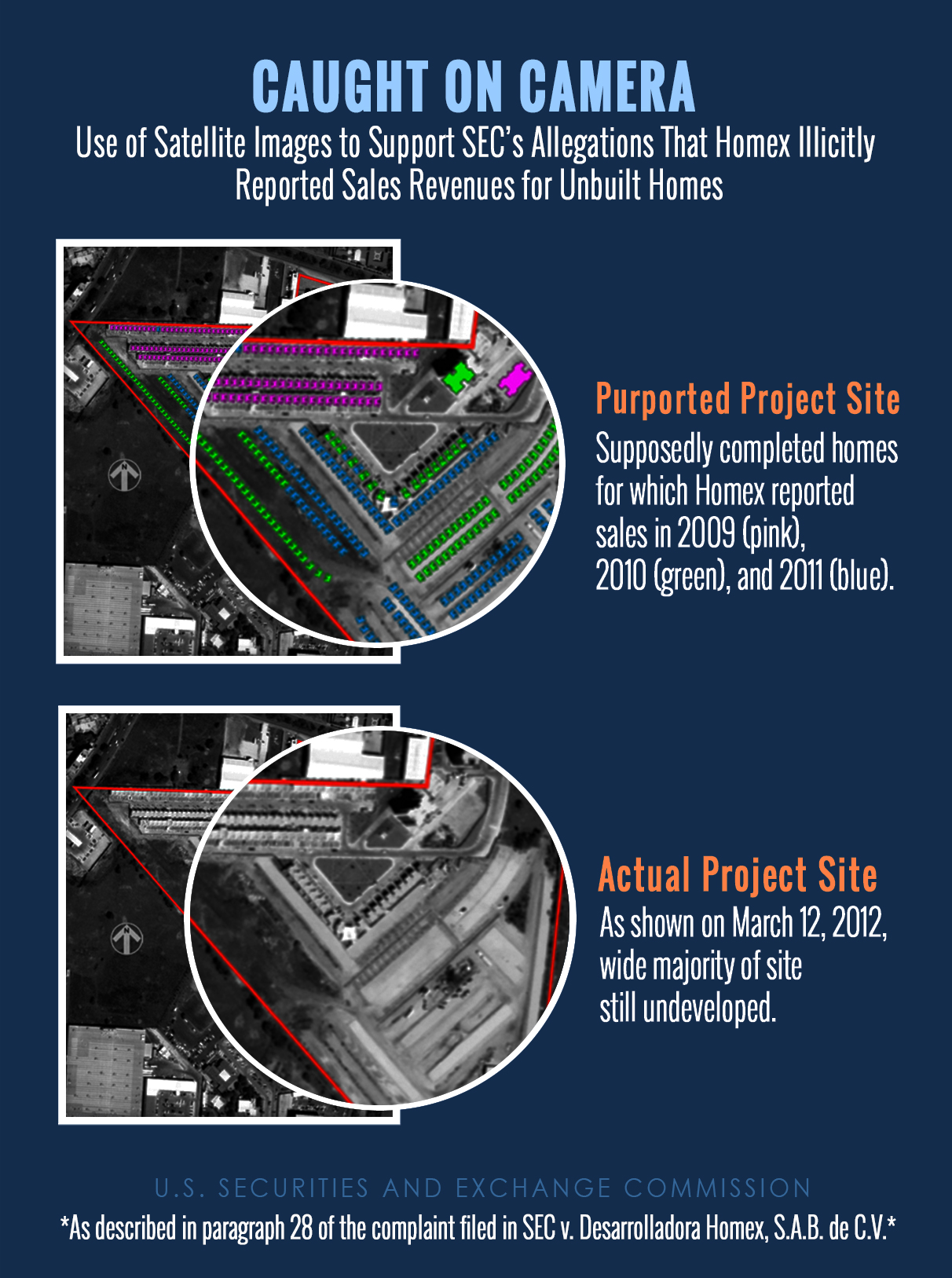
According to the SEC’s complaint, Homex filed for the Mexican equivalent of bankruptcy protection in April 2014 and emerged in October 2015 under new equity ownership. The company’s then-CEO and then-CFO have been placed on unpaid leave since May 2016. Homex has since undertaken significant remedial efforts and cooperated with the SEC’s investigation.
“As alleged in our complaint, Homex deprived its investors of accurate and reliable financial results by reporting key numbers that were almost completely made up,” said Stephanie Avakian, Acting Director of the SEC’s Enforcement Division. “The settlement takes into account that the fraud occurred entirely under the watch of prior ownership and management, the company’s new leaders provided critical information regarding the full scope of the fraudulent conduct, and the company continues to significantly cooperate with our ongoing investigation.”
Melissa Hodgman, Associate Director of the SEC’s Enforcement Division, added, “We used high-resolution satellite imagery and other innovative investigative techniques to unearth that tens of thousands of purportedly built-and-sold homes were, in fact, nothing but bare soil.”
The SEC separately issued a trading suspension in the securities of Homex.
Without admitting or denying the allegations in the SEC’s complaint filed in U.S. District Court for the Southern District of California, Homex consented to the entry of a final judgment permanently enjoining the company from violating the antifraud, reporting, and books and records provisions of the federal securities laws, and the company agreed to be prohibited from offering securities in the U.S. markets for at least five years. The settlement is subject to court approval.
The SEC’s investigation is being conducted by Alfred C. Tierney, Benjamin D. Brutlag, Andrew M. Shirley, Juan M. Migone and Richard Hong. The case is being supervised by J. Lee Buck II. The SEC appreciates the assistance of the Mexican Comisión Nacional Bancaria y de Valores.
Read MoreSEC Charges Mexico-Based Homebuilder in $3.3 Billion Accounting Fraud
The Securities and Exchange Commission today announced that Mexico-based homebuilding company Desarrolladora Homex S.A.B. de C.V. has agreed to settle charges that it reported fake sales of more than 100,000 homes to boost revenues in its financial statements during a three-year period. The SEC used satellite imagery to help uncover the accounting scheme and illustrate its allegation that Homex had not even broken ground on many of the homes for which it reported revenues. The SEC alleges that Homex, one of the largest homebuilders in Mexico at the time, inflated the number of homes sold during the three-year period by approximately 317 percent and overstated its revenue by 355 percent (approximately $3.3 billion). The SEC’s complaint highlights, for example, that Homex reported revenues from a project site in the Mexican state of Guanajuato where every planned home was purportedly built and sold by Dec. 31, 2011. Satellite images of the project site on March 12, 2012, show it was still largely undeveloped and the vast majority of supposedly sold homes remained unbuilt. According to the SEC’s complaint, Homex filed for the Mexican equivalent of bankruptcy protection in April 2014 and emerged in October 2015 under new equity ownership. The company’s then-CEO and then-CFO have been placed on unpaid leave since May 2016. Homex has since undertaken significant remedial efforts and cooperated with the SEC’s investigation. “As alleged in our complaint, Homex deprived its investors of accurate and reliable financial results by reporting key numbers that were almost completely made up,” said Stephanie Avakian, Acting Director of the SEC’s Enforcement Division. “The settlement takes into account that the fraud occurred entirely under the watch of prior ownership and management, the company’s new leaders provided critical information regarding the full scope of the fraudulent conduct, and the company continues to significantly cooperate with our ongoing investigation.” Melissa Hodgman, Associate Director of the SEC’s Enforcement Division, added, “We used high-resolution satellite imagery and other innovative investigative techniques to unearth that tens of thousands of purportedly built-and-sold homes were, in fact, nothing but bare soil.” The SEC separately issued a trading suspension in the securities of Homex. Without admitting or denying the allegations in the SEC’s complaint filed in U.S. District Court for the Southern District of California, Homex consented to the entry of a final judgment permanently enjoining the company from violating the antifraud, reporting, and books and records provisions of the federal securities laws, and the company agreed to be prohibited from offering securities in the U.S. markets for at least five years. The settlement is subject to court approval. The SEC’s investigation is being conducted by Alfred C. Tierney, Benjamin D. Brutlag, Andrew M. Shirley, Juan M. Migone and Richard Hong. The case is being supervised by J. Lee Buck II. The SEC appreciates the assistance of the Mexican Comisión Nacional Bancaria y de Valores.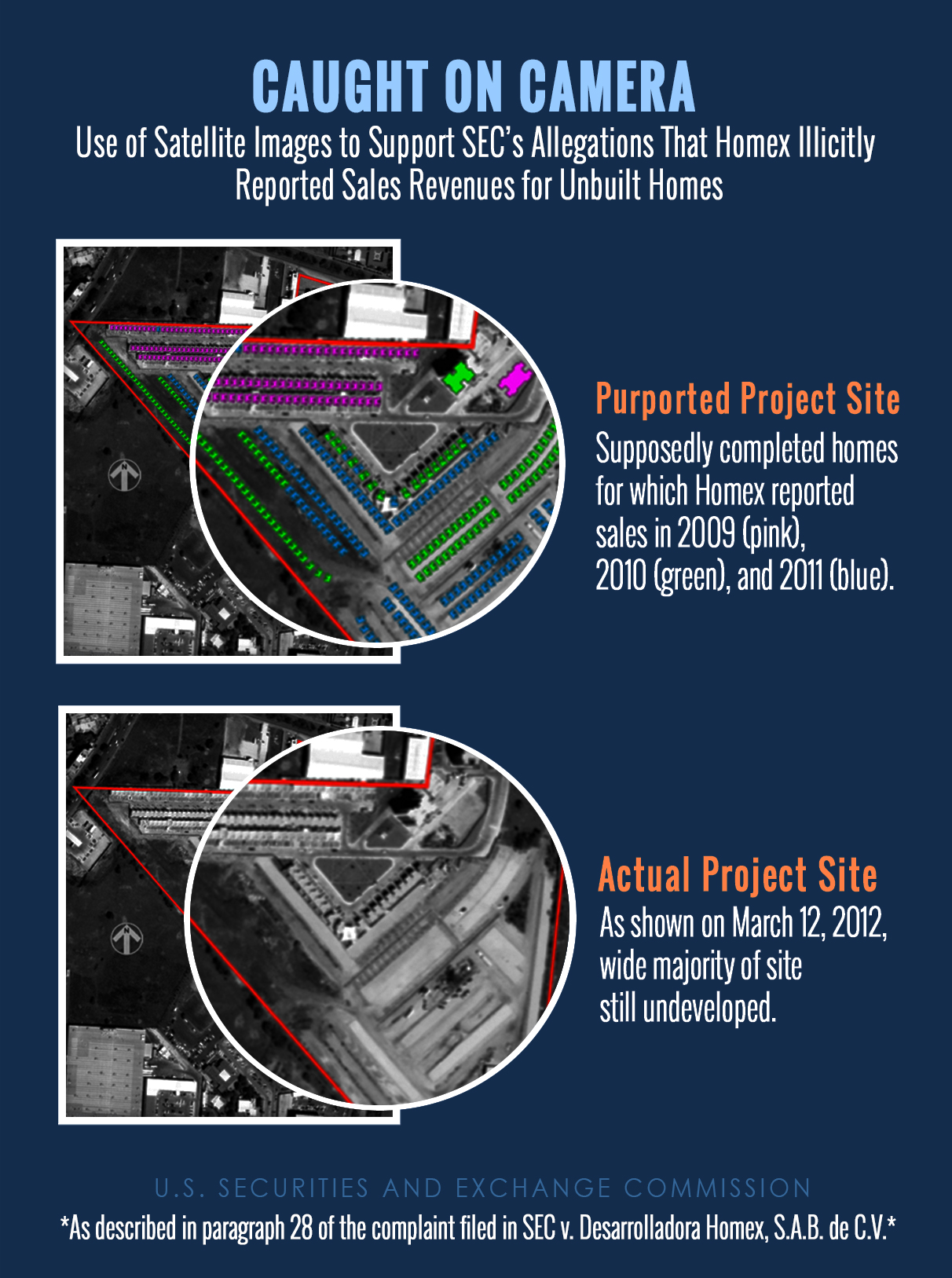
SEC’s Office of the Investor Advocate to Hold Evidence Summit, Launch Investor Research Initiative
The Securities and Exchange Commission’s Office of the Investor Advocate today announced it will host an Evidence Summit to discuss strategies for raising retail investors’ understanding of key investment characteristics such as fees, risks, returns, and conflicts of interest.
The March 10 Evidence Summit will mark the official launch of the SEC’s new investor research initiative led by the SEC’s Office of the Investor Advocate, dubbed ‘POSITIER’, also known as Policy Oriented Stakeholder and Investor Testing for Innovative and Effective Regulation.
POSITIER seeks to inform the rulemaking process with evidence obtained from surveys and specific testing projects. Under this initiative, the SEC’s Office of the Investor Advocate has launched a specific study program to examine the topic of Retail Disclosure Effectiveness. This study program seeks to identify and test interventions that increase investor awareness of key investment features and, in turn, improve investment outcomes.
“I am excited about the launch of POSITIER,” said Investor Advocate Rick Fleming, “because it has the potential to make a significant contribution to evidence-based policymaking at the Commission. With this new tool, we can gain better insights into the potential benefits to investors from proposed rule changes, and we will be able to help identify the best options amongst competing policy choices.”
Acting Chairman Michael Piwowar and Commissioner Kara Stein will speak at the event, as well as an interdisciplinary group of leading scholars in household and behavioral finance, psychology, marketing, and law. Although the focus will be on disclosure in the context of investment funds, the insights on improving the cognitive salience of information will be relevant to other financial disclosure contexts.
The Evidence Summit will be held at the SEC’s Washington, D.C. headquarters on Friday, March 10, 2017 and will be open to the public and webcast live on the SEC’s website. The agenda is available at https://www.sec.gov/page/positier.
Read More