

















Blog
SEC, NASAA Sign Info-Sharing Agreement for Crowdfunding and Other Offerings
The Securities and Exchange Commission and the North American Securities Administrators Association today signed an information-sharing agreement as new rules to facilitate intrastate crowdfunding offerings and regional offerings take effect.
The agreement signed by the SEC and NASAA is intended to facilitate the sharing of information to ensure that the new exemptions are serving their intended purpose of facilitating access to capital for small businesses. Under the memorandum of understanding (MOU), federal and state securities regulators will be better able to monitor the effects of the new rules and also guard against fraud.
The MOU was signed by SEC Acting Chairman Michael S. Piwowar and Mike Rothman, Minnesota Commissioner of Commerce and President of NASAA, which represents state securities administrators.
The agreement not only builds on an already productive relationship between the SEC and state regulators, it also offers additional insights and protections as we help companies grow and create jobs while providing new opportunities to investors.
-Acting Chairman Piwowar
“The agreement not only builds on an already productive relationship between the SEC and state regulators, it also offers additional insights and protections as we help companies grow and create jobs while providing new opportunities to investors,” said Acting Chairman Piwowar.
“This agreement will strengthen collaboration among state and federal securities regulators to help expand small-business investment opportunities while also protecting investors,” said Rothman. “Ongoing dialogue is essential to carry out our responsibilities going forward. With this MOU in place, we have an opportunity to share information that will bolster our efforts to support small business capital formation and prevent fraud.”
Under the new rules, companies will have more flexibility to engage in intrastate offers through websites and social media without having to register their offering with the federal government. Companies now can also raise up to $5 million per year through other amended rules, which could facilitate the development of regional offering exemptions at the state level to permit companies to raise from investors in a specific region. The previous limit was $1 million.
New JOBS Act rules went into effect in 2015 and 2016. New amendments to facilitate regional offerings went into effect in January and amendments to provide more flexibility for intrastate crowdfunding offerings will go into effect in April. These amendments are intended to facilitate greater access to capital for entrepreneurs that may not have been able to otherwise access capital using other alternatives. The MOU will increase the regulators’ ability to share data to better monitor implementation of the new rules and guard against fraud.
NASAA President Mike Rothman (L) and SEC Acting Chairman Michael Piwowar sign MOU.
Read MoreSEC, NASAA Sign Info-Sharing Agreement for Crowdfunding and Other Offerings
The Securities and Exchange Commission and the North American Securities Administrators Association today signed an information-sharing agreement as new rules to facilitate intrastate crowdfunding offerings and regional offerings take effect.
The agreement signed by the SEC and NASAA is intended to facilitate the sharing of information to ensure that the new exemptions are serving their intended purpose of facilitating access to capital for small businesses. Under the memorandum of understanding (MOU), federal and state securities regulators will be better able to monitor the effects of the new rules and also guard against fraud.
The MOU was signed by SEC Acting Chairman Michael S. Piwowar and Mike Rothman, Minnesota Commissioner of Commerce and President of NASAA, which represents state securities administrators.
The agreement not only builds on an already productive relationship between the SEC and state regulators, it also offers additional insights and protections as we help companies grow and create jobs while providing new opportunities to investors.
-Acting Chairman Piwowar
“The agreement not only builds on an already productive relationship between the SEC and state regulators, it also offers additional insights and protections as we help companies grow and create jobs while providing new opportunities to investors,” said Acting Chairman Piwowar.
“This agreement will strengthen collaboration among state and federal securities regulators to help expand small-business investment opportunities while also protecting investors,” said Rothman. “Ongoing dialogue is essential to carry out our responsibilities going forward. With this MOU in place, we have an opportunity to share information that will bolster our efforts to support small business capital formation and prevent fraud.”
Under the new rules, companies will have more flexibility to engage in intrastate offers through websites and social media without having to register their offering with the federal government. Companies now can also raise up to $5 million per year through other amended rules, which could facilitate the development of regional offering exemptions at the state level to permit companies to raise from investors in a specific region. The previous limit was $1 million.
New JOBS Act rules went into effect in 2015 and 2016. New amendments to facilitate regional offerings went into effect in January and amendments to provide more flexibility for intrastate crowdfunding offerings will go into effect in April. These amendments are intended to facilitate greater access to capital for entrepreneurs that may not have been able to otherwise access capital using other alternatives. The MOU will increase the regulators’ ability to share data to better monitor implementation of the new rules and guard against fraud.
NASAA President Mike Rothman (L) and SEC Acting Chairman Michael Piwowar sign MOU.
Read MoreSEC, NASAA Sign Info-Sharing Agreement for Crowdfunding and Other Offerings
The Securities and Exchange Commission and the North American Securities Administrators Association today signed an information-sharing agreement as new rules to facilitate intrastate crowdfunding offerings and regional offerings take effect.
The agreement signed by the SEC and NASAA is intended to facilitate the sharing of information to ensure that the new exemptions are serving their intended purpose of facilitating access to capital for small businesses. Under the memorandum of understanding (MOU), federal and state securities regulators will be better able to monitor the effects of the new rules and also guard against fraud.
The MOU was signed by SEC Acting Chairman Michael S. Piwowar and Mike Rothman, Minnesota Commissioner of Commerce and President of NASAA, which represents state securities administrators.
The agreement not only builds on an already productive relationship between the SEC and state regulators, it also offers additional insights and protections as we help companies grow and create jobs while providing new opportunities to investors.
-Acting Chairman Piwowar
“The agreement not only builds on an already productive relationship between the SEC and state regulators, it also offers additional insights and protections as we help companies grow and create jobs while providing new opportunities to investors,” said Acting Chairman Piwowar.
“This agreement will strengthen collaboration among state and federal securities regulators to help expand small-business investment opportunities while also protecting investors,” said Rothman. “Ongoing dialogue is essential to carry out our responsibilities going forward. With this MOU in place, we have an opportunity to share information that will bolster our efforts to support small business capital formation and prevent fraud.”
Under the new rules, companies will have more flexibility to engage in intrastate offers through websites and social media without having to register their offering with the federal government. Companies now can also raise up to $5 million per year through other amended rules, which could facilitate the development of regional offering exemptions at the state level to permit companies to raise from investors in a specific region. The previous limit was $1 million.
New JOBS Act rules went into effect in 2015 and 2016. New amendments to facilitate regional offerings went into effect in January and amendments to provide more flexibility for intrastate crowdfunding offerings will go into effect in April. These amendments are intended to facilitate greater access to capital for entrepreneurs that may not have been able to otherwise access capital using other alternatives. The MOU will increase the regulators’ ability to share data to better monitor implementation of the new rules and guard against fraud.
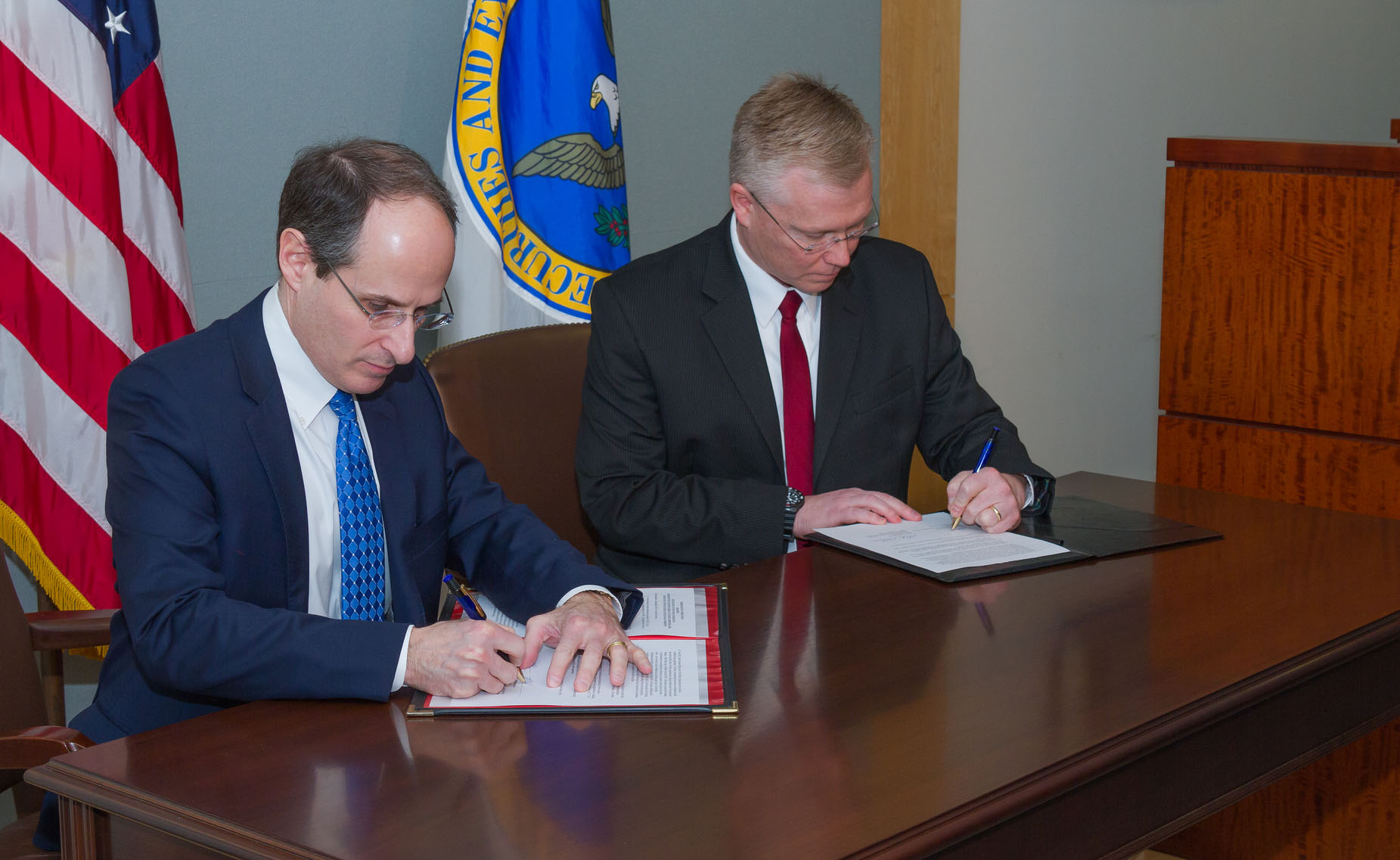
NASAA President Mike Rothman (L) and SEC Acting Chairman Michael Piwowar sign MOU.
SEC, NASAA Sign Info-Sharing Agreement for Crowdfunding and Other Offerings
The Securities and Exchange Commission and the North American Securities Administrators Association today signed an information-sharing agreement as new rules to facilitate intrastate crowdfunding offerings and regional offerings take effect.
The agreement signed by the SEC and NASAA is intended to facilitate the sharing of information to ensure that the new exemptions are serving their intended purpose of facilitating access to capital for small businesses. Under the memorandum of understanding (MOU), federal and state securities regulators will be better able to monitor the effects of the new rules and also guard against fraud.
The MOU was signed by SEC Acting Chairman Michael S. Piwowar and Mike Rothman, Minnesota Commissioner of Commerce and President of NASAA, which represents state securities administrators.
The agreement not only builds on an already productive relationship between the SEC and state regulators, it also offers additional insights and protections as we help companies grow and create jobs while providing new opportunities to investors.
-Acting Chairman Piwowar
“The agreement not only builds on an already productive relationship between the SEC and state regulators, it also offers additional insights and protections as we help companies grow and create jobs while providing new opportunities to investors,” said Acting Chairman Piwowar.
“This agreement will strengthen collaboration among state and federal securities regulators to help expand small-business investment opportunities while also protecting investors,” said Rothman. “Ongoing dialogue is essential to carry out our responsibilities going forward. With this MOU in place, we have an opportunity to share information that will bolster our efforts to support small business capital formation and prevent fraud.”
Under the new rules, companies will have more flexibility to engage in intrastate offers through websites and social media without having to register their offering with the federal government. Companies now can also raise up to $5 million per year through other amended rules, which could facilitate the development of regional offering exemptions at the state level to permit companies to raise from investors in a specific region. The previous limit was $1 million.
New JOBS Act rules went into effect in 2015 and 2016. New amendments to facilitate regional offerings went into effect in January and amendments to provide more flexibility for intrastate crowdfunding offerings will go into effect in April. These amendments are intended to facilitate greater access to capital for entrepreneurs that may not have been able to otherwise access capital using other alternatives. The MOU will increase the regulators’ ability to share data to better monitor implementation of the new rules and guard against fraud.
NASAA President Mike Rothman (L) and SEC Acting Chairman Michael Piwowar sign MOU.
SEC Charges Fuel Cell Company and Officers With Defrauding Investors
The Securities and Exchange Commission today charged a California-based penny stock company and four corporate officers with misleading investors about the research, development, and profitability of their purported business to manufacture power generation products such as fuel cells.
The SEC alleges that while raising approximately $7.9 million from investors in Terminus Energy Inc., the company and its officers claimed to have a viable prototype capable of being sold and earning revenue. According to the SEC’s complaint, Terminus did not have the fuel cell technology or the funding to match their claims, and the officers were instead converting substantial amounts of investor funds to their own use.
According to the SEC’s complaint, the company failed to disclose to investors that Terminus’s operations manager George Doumanis is a convicted felon who went to prison for securities fraud and was secretly acting as an officer of the company despite being barred from participating in penny stock offerings. Emanuel Pantelakis served on the Terminus board of directors despite having been permanently barred by the Financial Industry Regulatory Authority. Also charged in the SEC’s complaint are Terminus’s CEO Danny B. Pratte and its former president, director, and legal counsel Joseph L. Pittera.
Terminus also allegedly used unregistered brokers to sell its securities and paid them more than twice as much in commissions than was disclosed to investors in offering documents. Joseph Alborano is charged in the SEC’s complaint with soliciting and selling investments for which he received more than $1 million in commissions.
“As alleged in our complaint, these company insiders spent massive, undisclosed amounts of investor funds and left the company with no realistic chance of developing a fuel cell product,” said Eric I. Bustillo, Director of the SEC’s Miami Regional Office.
In a parallel action, the U.S. Attorney’s Office for the Southern District of New York today filed criminal charges against Pratte, Doumanis, and Pantelakis.
The SEC’s complaint seeks disgorgement of ill-gotten gains plus interest and penalties as well as officer-and-director bars and penny stock bars.
The SEC’s investigation, which is continuing, is being conducted by Robert H. Murphy and Mark Dee in the Miami office. The case is being supervised by Jessica M. Weissman, and the litigation is being led by Alejandro Soto. The SEC appreciates the assistance of the U.S. Attorney’s Office for the Southern District of New York and the Federal Bureau of Investigation.
Read MoreSEC Announces Cases Related to Disclosures During Battles for Corporate Control
The Securities and Exchange Commission today announced two enforcement actions involving disclosure violations that deprived investors of material information during battles for corporate control of publicly traded companies.
In one case, the SEC’s order finds that Texas-based oil refinery company CVR Energy made inadequate disclosures in SEC filings about “success fee” arrangements with two investment banks retained by the company to fend off a hostile takeover bid. Shareholders were consequently unaware of potential conflicts of interest that stemmed from the fee arrangements, namely that the banks could still earn success fees even if the hostile bidder secured control of the company. CVR agreed to settle the case without admitting or denying the findings in the SEC’s order, which notes that the company will not pay a penalty due to its remedial acts and extensive cooperation with the investigation.
The SEC’s order in the other case finds that groups of investors failed to properly disclose ownership information during a series of five campaigns to influence or exert control over microcap companies. Jeffrey E. Eberwein and Charles M. Gillman collaborated with mutual fund adviser Heartland Advisors in some of these campaigns, and other campaigns involved a hedge fund adviser headed by Eberwein called Lone Star Value Management and a private fund advised by Gillman called Boston Avenue Capital. In each of these campaigns, the groups collectively owned more than five percent and sometimes even more than 10 percent of the companies’ outstanding common stock, yet the required ownership filings to disclose that information to the investing public were either incomplete, untimely, or altogether absent. Without admitting or denying the findings, they consented to the SEC’s order and agreed to penalties of $90,000 for Eberwein, $30,000 for Gillman, $120,000 for Lone Star Value Management, and $180,000 for Heartland Advisors.
“Full, fair, and accurate disclosures from all parties in a battle for corporate influence or control are critically important to investors particularly when they are called upon to make decisions about their investments,” said Gerald Hodgkins, Associate Director of the SEC Division of Enforcement. “Investors in these companies were deprived of key facts needed to make informed investment decisions.”
The SEC’s investigation into CVR was conducted by Nicholas A. Brady and supervised by Anita B. Bandy, and the other investigation was conducted by Jonathan M. Cowen and supervised by Jeffrey P. Weiss. Providing assistance in both investigations was Nicholas Panos of the SEC Division of Corporation Finance’s Office of Mergers & Acquisitions.
Read MorePurported Real Estate Investment Manager Settles Fraud Charges
The Securities and Exchange Commission today announced that a purported real estate investment manager has agreed to pay more than a half-million dollars to settle charges that he pocketed investor money in an investment scheme.
The SEC alleges that James P. Toner Jr. of Scottsdale, Ariz., siphoned $51,000 from investors who were falsely told that he would personally manage some of the real estate projects in which they were purchasing interests. The stated purpose of each investor offering was to purchase a residential property in the Phoenix area, renovate that property, and then sell it for a profit.
According to the SEC’s complaint, Toner took $31,000 in undisclosed management fees even though he did not manage any of the offerings, and stole $20,000 directly from an investor. Without conducting any due diligence, Toner allegedly entrusted the management of the investments to a real estate broker who subsequently squandered investor funds. According to the SEC’s complaint, the real estate broker was later imprisoned for other crimes.
In addition to falsely stating that he planned to personally manage some of the properties, Toner allegedly told investors he would make personal investments in the projects when in fact he never did. In order to skirt the registration requirements for the offerings, Toner allegedly instructed some investors to falsely state that they were accredited investors.
“As alleged in our complaint, Toner defrauded investors with false promises that he would manage their investments and personally invest along with them. Instead he siphoned off some investor money as management fees and handed over the rest to a third party without any due diligence,” said Andrew M. Calamari, Director of the SEC’s New York Regional Office.
Without admitting or denying the allegations, Toner consented to the entry of a court order requiring him to pay disgorgement of $51,358 plus interest of $4,893.98 and a penalty of $450,000. The settlement is subject to court approval.
The SEC’s investigation was conducted in the New York office by Jorge G. Tenreiro, Elizabeth Butler, Neil Hendelman, and Sandeep Satwalekar, and the case was supervised by Sanjay Wadhwa. The SEC appreciates the assistance of the Internal Revenue Service, U.S. Attorney’s Office for the District of Arizona, and Pennsylvania Attorney General’s office.
Read MoreMorgan Stanley Settles Charges Related to ETF Investments
The Securities and Exchange Commission today announced that Morgan Stanley Smith Barney has agreed to pay an $8 million penalty and admit wrongdoing to settle charges related to single inverse ETF investments it recommended to advisory clients.
The SEC’s order finds that Morgan Stanley did not adequately implement its policies and procedures to ensure that clients understood the risks involved with purchasing inverse ETFs. Among the order’s findings, Morgan Stanley failed to obtain from several hundred clients a signed client disclosure notice, which stated that single inverse ETFs were typically unsuitable for investors planning to hold them longer than one trading session unless used as part of a trading or hedging strategy. Morgan Stanley solicited clients to purchase single inverse ETFs in retirement and other accounts, the securities were held long-term, and many of the clients experienced losses.
The SEC’s order further finds that Morgan Stanley failed to follow through on another key policy and procedure requiring a supervisor to conduct risk reviews to evaluate the suitability of inverse ETFs for each advisory client. Among other compliance failures, Morgan Stanley did not monitor the single-inverse ETF positions on an ongoing basis and did not ensure that certain financial advisers completed single inverse ETF training.
“Morgan Stanley recommended securities with unique risks and failed to follow its policies and procedures to ensure they were suitable for all clients,” said Antonia Chion, Associate Director of the SEC Enforcement Division.
The SEC’s investigation was conducted by Breanne Atzert, Helaine Schwartz, and Stephan Schlegelmilch, and the case was supervised by Lisa Deitch and Antonia Chion.
* * *
Investors can learn more about the risks involved with leveraged and inverse ETFs by reading an investor alert issued by the SEC and FINRA.
Read MoreSEC Charges Fuel Cell Company and Officers With Defrauding Investors
The Securities and Exchange Commission today charged a California-based penny stock company and four corporate officers with misleading investors about the research, development, and profitability of their purported business to manufacture power generation products such as fuel cells.
The SEC alleges that while raising approximately $7.9 million from investors in Terminus Energy Inc., the company and its officers claimed to have a viable prototype capable of being sold and earning revenue. According to the SEC’s complaint, Terminus did not have the fuel cell technology or the funding to match their claims, and the officers were instead converting substantial amounts of investor funds to their own use.
According to the SEC’s complaint, the company failed to disclose to investors that Terminus’s operations manager George Doumanis is a convicted felon who went to prison for securities fraud and was secretly acting as an officer of the company despite being barred from participating in penny stock offerings. Emanuel Pantelakis served on the Terminus board of directors despite having been permanently barred by the Financial Industry Regulatory Authority. Also charged in the SEC’s complaint are Terminus’s CEO Danny B. Pratte and its former president, director, and legal counsel Joseph L. Pittera.
Terminus also allegedly used unregistered brokers to sell its securities and paid them more than twice as much in commissions than was disclosed to investors in offering documents. Joseph Alborano is charged in the SEC’s complaint with soliciting and selling investments for which he received more than $1 million in commissions.
“As alleged in our complaint, these company insiders spent massive, undisclosed amounts of investor funds and left the company with no realistic chance of developing a fuel cell product,” said Eric I. Bustillo, Director of the SEC’s Miami Regional Office.
In a parallel action, the U.S. Attorney’s Office for the Southern District of New York today filed criminal charges against Pratte, Doumanis, and Pantelakis.
The SEC’s complaint seeks disgorgement of ill-gotten gains plus interest and penalties as well as officer-and-director bars and penny stock bars.
The SEC’s investigation, which is continuing, is being conducted by Robert H. Murphy and Mark Dee in the Miami office. The case is being supervised by Jessica M. Weissman, and the litigation is being led by Alejandro Soto. The SEC appreciates the assistance of the U.S. Attorney’s Office for the Southern District of New York and the Federal Bureau of Investigation.
Read MoreSEC Charges Fuel Cell Company and Officers With Defrauding Investors
The Securities and Exchange Commission today charged a California-based penny stock company and four corporate officers with misleading investors about the research, development, and profitability of their purported business to manufacture power generation products such as fuel cells.
The SEC alleges that while raising approximately $7.9 million from investors in Terminus Energy Inc., the company and its officers claimed to have a viable prototype capable of being sold and earning revenue. According to the SEC’s complaint, Terminus did not have the fuel cell technology or the funding to match their claims, and the officers were instead converting substantial amounts of investor funds to their own use.
According to the SEC’s complaint, the company failed to disclose to investors that Terminus’s operations manager George Doumanis is a convicted felon who went to prison for securities fraud and was secretly acting as an officer of the company despite being barred from participating in penny stock offerings. Emanuel Pantelakis served on the Terminus board of directors despite having been permanently barred by the Financial Industry Regulatory Authority. Also charged in the SEC’s complaint are Terminus’s CEO Danny B. Pratte and its former president, director, and legal counsel Joseph L. Pittera.
Terminus also allegedly used unregistered brokers to sell its securities and paid them more than twice as much in commissions than was disclosed to investors in offering documents. Joseph Alborano is charged in the SEC’s complaint with soliciting and selling investments for which he received more than $1 million in commissions.
“As alleged in our complaint, these company insiders spent massive, undisclosed amounts of investor funds and left the company with no realistic chance of developing a fuel cell product,” said Eric I. Bustillo, Director of the SEC’s Miami Regional Office.
In a parallel action, the U.S. Attorney’s Office for the Southern District of New York today filed criminal charges against Pratte, Doumanis, and Pantelakis.
The SEC’s complaint seeks disgorgement of ill-gotten gains plus interest and penalties as well as officer-and-director bars and penny stock bars.
The SEC’s investigation, which is continuing, is being conducted by Robert H. Murphy and Mark Dee in the Miami office. The case is being supervised by Jessica M. Weissman, and the litigation is being led by Alejandro Soto. The SEC appreciates the assistance of the U.S. Attorney’s Office for the Southern District of New York and the Federal Bureau of Investigation.
Read MoreSEC Announces Cases Related to Disclosures During Battles for Corporate Control
The Securities and Exchange Commission today announced two enforcement actions involving disclosure violations that deprived investors of material information during battles for corporate control of publicly traded companies.
In one case, the SEC’s order finds that Texas-based oil refinery company CVR Energy made inadequate disclosures in SEC filings about “success fee” arrangements with two investment banks retained by the company to fend off a hostile takeover bid. Shareholders were consequently unaware of potential conflicts of interest that stemmed from the fee arrangements, namely that the banks could still earn success fees even if the hostile bidder secured control of the company. CVR agreed to settle the case without admitting or denying the findings in the SEC’s order, which notes that the company will not pay a penalty due to its remedial acts and extensive cooperation with the investigation.
The SEC’s order in the other case finds that groups of investors failed to properly disclose ownership information during a series of five campaigns to influence or exert control over microcap companies. Jeffrey E. Eberwein and Charles M. Gillman collaborated with mutual fund adviser Heartland Advisors in some of these campaigns, and other campaigns involved a hedge fund adviser headed by Eberwein called Lone Star Value Management and a private fund advised by Gillman called Boston Avenue Capital. In each of these campaigns, the groups collectively owned more than five percent and sometimes even more than 10 percent of the companies’ outstanding common stock, yet the required ownership filings to disclose that information to the investing public were either incomplete, untimely, or altogether absent. Without admitting or denying the findings, they consented to the SEC’s order and agreed to penalties of $90,000 for Eberwein, $30,000 for Gillman, $120,000 for Lone Star Value Management, and $180,000 for Heartland Advisors.
“Full, fair, and accurate disclosures from all parties in a battle for corporate influence or control are critically important to investors particularly when they are called upon to make decisions about their investments,” said Gerald Hodgkins, Associate Director of the SEC Division of Enforcement. “Investors in these companies were deprived of key facts needed to make informed investment decisions.”
The SEC’s investigation into CVR was conducted by Nicholas A. Brady and supervised by Anita B. Bandy, and the other investigation was conducted by Jonathan M. Cowen and supervised by Jeffrey P. Weiss. Providing assistance in both investigations was Nicholas Panos of the SEC Division of Corporation Finance’s Office of Mergers & Acquisitions.
Read MorePurported Real Estate Investment Manager Settles Fraud Charges
The Securities and Exchange Commission today announced that a purported real estate investment manager has agreed to pay more than a half-million dollars to settle charges that he pocketed investor money in an investment scheme.
The SEC alleges that James P. Toner Jr. of Scottsdale, Ariz., siphoned $51,000 from investors who were falsely told that he would personally manage some of the real estate projects in which they were purchasing interests. The stated purpose of each investor offering was to purchase a residential property in the Phoenix area, renovate that property, and then sell it for a profit.
According to the SEC’s complaint, Toner took $31,000 in undisclosed management fees even though he did not manage any of the offerings, and stole $20,000 directly from an investor. Without conducting any due diligence, Toner allegedly entrusted the management of the investments to a real estate broker who subsequently squandered investor funds. According to the SEC’s complaint, the real estate broker was later imprisoned for other crimes.
In addition to falsely stating that he planned to personally manage some of the properties, Toner allegedly told investors he would make personal investments in the projects when in fact he never did. In order to skirt the registration requirements for the offerings, Toner allegedly instructed some investors to falsely state that they were accredited investors.
“As alleged in our complaint, Toner defrauded investors with false promises that he would manage their investments and personally invest along with them. Instead he siphoned off some investor money as management fees and handed over the rest to a third party without any due diligence,” said Andrew M. Calamari, Director of the SEC’s New York Regional Office.
Without admitting or denying the allegations, Toner consented to the entry of a court order requiring him to pay disgorgement of $51,358 plus interest of $4,893.98 and a penalty of $450,000. The settlement is subject to court approval.
The SEC’s investigation was conducted in the New York office by Jorge G. Tenreiro, Elizabeth Butler, Neil Hendelman, and Sandeep Satwalekar, and the case was supervised by Sanjay Wadhwa. The SEC appreciates the assistance of the Internal Revenue Service, U.S. Attorney’s Office for the District of Arizona, and Pennsylvania Attorney General’s office.
Read More