















SEC Releases
Executives Charged With Manipulating Company’s Accounting Systems to Steal Money
The Securities and Exchange Commission today charged two former executives at a credit card processing company with masterminding a fraudulent scheme to steal millions of dollars through phony expense reimbursements, inflated invoices, and other improper accounting tactics.
The SEC’s complaint alleges that iPayment’s then-senior vice president of sales and marketing Nasir N. Shakouri and then-executive vice president and chief operating officer Robert S. Torino routinely reimbursed themselves for payments that were never actually made to third-party vendors using their personal credit cards. They also allegedly conspired with vendors to inflate invoices and receive kickbacks from the overpayments, and claimed improper commissions and bonuses related to other corporate funds they improperly diverted in various ways.
The SEC’s complaint also charges three other iPayment executives – Bronson L. Quon, John S. Hong, and Jonathan K. Skarie – with participating in the scheme and helping Shakouri and Torino falsify books and records to hide the thefts of corporate funds. Quon, Hong, and Skarie were allegedly rewarded for their assistance with misappropriated iPayment funds.
“As alleged in our complaint, these executives manipulated iPayment’s internal accounting systems, lied to the external auditor, and caused approximately $11.6 million in losses to the company,” said Sanjay Wadhwa, Senior Associate Director of the SEC’s New York Regional Office.
In a parallel action, the U.S. Attorney’s Office for the Central District of California today announced criminal charges against Shakouri and Torino.
The SEC is seeking disgorgement of ill-gotten gains plus interest and penalties as well as officer-and-director bars.
The SEC’s investigation has been conducted by Kristin M. Pauley, Melissa A. Coppola, Maureen P. King, Roseann Daniello, Diego Brucculeri, Richard Hong, Nicholas Pilgrim, Scott B. York, and Valerie A. Szczepanik in the New York office. The litigation will be led by Mr. Hong and Ms. Pauley along with John Bulgozdy, who works in the Los Angeles office. The case is being supervised by Mr. Wadhwa. The SEC appreciates the assistance of the U.S. Attorney’s Office for the Central District of California, the Federal Bureau of Investigation, and the Internal Revenue Service.
Read MoreSEC Charges Firms Involved in Layering, Manipulation Schemes
The Securities and Exchange Commission today announced fraud charges against a Ukraine-based trading firm accused of manipulating the U.S. markets hundreds of thousands of times and the New York-based brokerage firm and CEO who allegedly helped make it possible.
The SEC’s complaint alleges that Avalon FA Ltd touted itself to traders as a destination to engage in layering, a scheme in which orders are placed but later canceled after tricking others into buying or selling stocks at artificial prices, resulting in illicit profits. Avalon allegedly made more than $21 million in the layering scheme involving U.S. stocks during a five-year period. According to the SEC’s complaint, Avalon also made more than $7 million in illicit profits through a cross-market manipulation scheme in which the firm bought and sold U.S. stocks at a loss in order to manipulate the prices of the stock and its corresponding options so that it could then profitably trade at artificial prices. Avalon allegedly used traders in Eastern Europe and Asia to conduct its trading, and the firm kept a portion of the profits and collected commissions from the traders.
The SEC’s complaint also describes fraud charges against Avalon’s named owner Nathan Fayyer and Sergey Pustelnik, who allegedly kept his controlling interest in Avalon undisclosed and embedded himself at Lek Securities as a registered representative, using his position to facilitate the schemes.
The SEC further alleges that Lek Securities and its owner Samuel Lek made the schemes possible by providing Avalon with access to the U.S. markets, approving the cross-market trading scheme, and improving its trading technology to assist Avalon’s trading. According to the SEC’s complaint, Lek Securities also relaxed its layering controls after Avalon complained. Avalon was the highest-producing customer for Lek Securities in terms of trading commissions, fees, and rebates generated.
“As alleged in our complaint, Avalon openly marketed itself as a destination for manipulative trading, and Lek Securities opened the gate to allow the schemes into the U.S. markets despite repeated warnings that its customer was manipulating the market,” said Stephanie Avakian, Acting Director of the SEC’s Division of Enforcement.
After filing its complaint in U.S. District Court for the Southern District of New York, the SEC obtained an emergency court order freezing Avalon’s assets held in its account at Lek Securities as well as freezing and repatriating funds that Avalon has transferred overseas.
The SEC’s investigation was conducted by Sarah S. Nilson along with Owen A. Granke and Carolyn Welshhans of the Market Abuse Unit. The case was supervised by Melissa Hodgman, Antonia Chion, and Robert A. Cohen. The litigation will be led by David J. Gottesman, Olivia S. Choe, and Ms. Nilson. The SEC appreciates the assistance of the Financial Industry Regulatory Authority.
Read MoreSEC Charges Marijuana-Related Company and Executives With Touting Bogus Revenues
The Securities and Exchange Commission today charged a California-based company and its founder with falsely touting “record” revenue numbers to investors and claiming to be a leader in the marijuana industry while some of its earnings came from sham transactions with a secret affiliate.
According to the SEC’s complaint, Medbox provided marijuana consulting services and claimed to sell vending machines known as “Medbox” devices capable of dispensing marijuana on the basis of biometric identification. The SEC alleges that Vincent Mehdizadeh created a shell company called New-Age Investment Consulting to carry out illegal stock sales and used the proceeds from those sales to boost Medbox’s revenue. Medbox allegedly issued press releases headlining the phony revenues as record earnings to legitimize itself as a viable commercial operation when in fact nearly 90 percent of the company’s revenue in the first quarter of 2014 stemmed from sham transactions with New-Age. Mehdizadeh allegedly acknowledged in a text message that “the only thing we are really good at is public company publicity and stock awareness. We get an A+ for creating revenue off sheer will but that won’t continue.”
Meanwhile, according to the SEC’s complaint, Mehdizadeh funded the purchase of a luxury home in the Pacific Palisades with proceeds from New-Age’s illicit stock sales.
The SEC’s complaint additionally charges Medbox’s then-CEO Bruce Bedrick with being complicit in the scheme and personally profiting. The SEC also charged New-Age and Mehdizadeh’s then-fiancée Yocelin Legaspi with unlawfully selling unregistered securities. Mehdizadeh installed Legaspi as the supposed CEO of New-Age when he created the company.
“As alleged in our complaint, investors were misled into believing that Medbox was a leader in the burgeoning marijuana industry when the company was just round-tripping money from illegal stock sales to boost revenue,” said Michele Wein Layne, Director of the SEC’s Los Angeles Regional Office.
Mehdizadeh and Medbox, which has since changed its name to Notis Global, have agreed to settle the SEC’s charges. Mehdizadeh agreed to pay more than $12 million in disgorgement and penalties and agreed to be barred from serving as an officer or director of a public company or participating in any penny stock offerings. The settlements are subject to court approval. The SEC’s litigation continues against Bedrick, Legaspi, and New-Age.
The SEC’s investigation was conducted by Megan M. Bergstrom, Roger Boudreau, and Spencer Bendell of the Los Angeles office. The litigation will be led by Gary Leung. The SEC appreciates the assistance of the Financial Industry Regulatory Authority.
Read MoreSEC Posts Notice of Availability of IFRS Taxonomy
Normal
0
false
false
false
EN-US
JA
X-NONE
/* Style Definitions */
table.MsoNormalTable
{mso-style-name:”Table Normal”;
mso-tstyle-rowband-size:0;
mso-tstyle-colband-size:0;
mso-style-noshow:yes;
mso-style-priority:99;
mso-style-parent:””;
mso-padding-alt:0in 5.4pt 0in 5.4pt;
mso-para-margin:0in;
mso-para-margin-bottom:.0001pt;
mso-pagination:widow-orphan;
font-size:10.0pt;
font-family:”Times New Roman”;}
The Securities and Exchange Commission today published a taxonomy on its website so that foreign private issuers that prepare their financial statements in accordance with International Financial Reporting Standards (IFRS) may submit those reports using XBRL. XBRL is a machine readable data format that allows investors and other data users to more easily access, analyze and compare financial information across reporting periods and across companies.
Foreign private issuers that prepare their financial statements in accordance with IFRS as issued by the IASB may begin immediately to submit their financial statements in XBRL. Otherwise, all such foreign private issuers must submit their financial statements in XBRL for fiscal periods ending on or after December 15, 2017.
“Foreign private issuers will use the published IFRS Taxonomy for IFRS financial statements, which will enable the public to take advantage of enhanced data analysis of those financial statements, as they already can with financial statements of issuers that prepare their financial statements in accordance with U.S. accounting standards,” said Acting Chairman Michael Piwowar.
In 2009, the Commission adopted requirements for structuring certain foreign private issuer financial statements in XBRL once an IFRS taxonomy was specified on the Commission’s website, SEC.gov.
Read MoreSEC Proposes Rule Amendments to Improve Municipal Securities Disclosures
The Securities and Exchange Commission today voted to propose rule amendments to improve investor protection and enhance transparency in the municipal securities market.
Rule 15c2-12 under the Securities Exchange Act of 1934 requires brokers, dealers, and municipal securities dealers that are acting as underwriters in primary offerings of municipal securities subject to the Rule, to reasonably determine, among other things, that the issuer or obligated person has agreed to provide to the Municipal Securities Rulemaking Board (MSRB) timely notice of certain events. The amendments proposed by the SEC today would add two new event notices:
– Incurrence of a financial obligation of the issuer or obligated person, if material, or agreement to covenants, events of default, remedies, priority rights, or other similar terms of a financial obligation of the issuer or obligated person, any of which affect security holders, if material; and
– Default, event of acceleration, termination event, modification of terms, or other similar events under the terms of the financial obligation of the issuer or obligated person, any of which reflect financial difficulties.
“Today the SEC took steps to empower investors by improving their access to current information about the financial obligations incurred by municipal issuers and conduit borrowers,” said SEC Acting Chairman Michael S. Piwowar.
These proposed amendments would provide timely access to important information regarding certain financial obligations incurred by issuers and obligated persons that could impact such entities’ liquidity and overall creditworthiness.
The public comment period will remain open for 60 days following publication of the proposing release in the Federal Register.
* * *
FACT SHEET
SEC Open Meeting
March 1, 2017
Action
The Commission will consider whether to propose amendments designed to better inform investors and other market participants about the current financial condition of issuers of municipal securities and obligated persons. Specifically, the proposed amendments would facilitate timely access to important information regarding certain financial obligations incurred by issuers and obligated persons, which could impact an issuer’s or obligated person’s liquidity and overall creditworthiness and create risks for existing security holders.
Highlights
The proposed amendments to Exchange Act Rule 15c2-12 would amend the list of event notices that a broker, dealer, or municipal securities dealer acting as an underwriter in a primary offering of municipal securities subject to the Rule must reasonably determine that an issuer or obligated person has undertaken, in a written agreement for the benefit of holders of municipal securities, to provide to the Municipal Securities Rulemaking Board within ten business days of the event’s occurrence.
Specifically, the proposed amendments would add two new events to the list included in the Rule:
- Incurrence of a financial obligation of the issuer or obligated person, if material, or agreement to covenants, events of default, remedies, priority rights, or other similar terms of a financial obligation of the issuer or obligated person, any of which affect security holders, if material and
- Default, event of acceleration, termination event, modification of terms, or other similar events under the terms of the financial obligation of the issuer or obligated person, any of which reflect financial difficulties
The proposed amendments also would set forth a definition for the term “financial obligation.”
Background
Adopted in 1989, Rule 15c2-12 is designed to address fraud and manipulation in the municipal securities market by prohibiting the underwriting of municipal securities and subsequent recommendation of those municipal securities by brokers, dealers, and municipal securities dealers for which adequate information is not available.
What’s Next
The Commission will seek public comment on the proposed amendments to Rule 15c2-12 for 60 days following publication in the Federal Register.
Read MoreSEC Announces Agenda for March 9 Investor Advisory Committee Meeting
The Securities and Exchange Commission today announced the agenda for the March 9 meeting of its Investor Advisory Committee. The meeting will commence at 9:30 a.m. in the Multipurpose Room at SEC headquarters at 100 F Street, N.E., Washington, D.C. and is open to the public. The meeting will be webcast live and archived on the committee’s website for later viewing.
The committee will hold two panel discussions, one on research into investor behavior and financial capability and another on unequal voting rights of common shares.
The committee welcomes new member Jerome H. Solomon, a fixed-income portfolio manager at Capital Group. Members of the committee represent a wide variety of investor interests, including those of individual and institutional investors, senior citizens, and state securities commissions. For a full list of committee members, see the committee’s webpage.
The Investor Advisory Committee was established under Section 911 of the Dodd-Frank Act to advise the SEC on regulatory priorities, the regulation of securities products, trading strategies, fee structures, the effectiveness of disclosure, and on initiatives to protect investor interests and to promote investor confidence and the integrity of the securities marketplace. The Dodd-Frank Act authorizes the committee to submit findings and recommendations to the Commission.
Read MoreSEC Staff Issues Guidance Update and Investor Bulletin on Robo-Advisers
The Securities and Exchange Commission today published information and guidance for investors and the financial services industry on the fast-growing use of robo-advisers, which are registered investment advisers that use computer algorithms to provide investment advisory services online with often limited human interaction.
Because of the unique issues raised by robo-advisers, the Commission’s Division of Investment Management issued guidance for investment advisers with suggestions on meeting disclosure, suitability and compliance obligations under the Investment Advisers Act of 1940.
A second publication, an Investor Bulletin issued by the SEC’s Office of Investor Education and Advocacy, provides individual investors with information they may need to make informed decisions if they consider using robo-advisers.
The Investor Bulletin describes a number of issues investors should consider, including:
- The level of human interaction important to the investor
- The information the robo-adviser uses in formulating recommendations
- The robo-adviser’s approach to investing
- The fees and charges involved
“As technology continues to improve and make profound changes to the financial services industry, it’s important for regulators to assess its impact on U.S. markets and give thoughtful guidance to market participants,” said SEC Acting Chairman Michael Piwowar. “ This information is designed to help investors tap into the opportunities that fintech innovation can provide while ensuring fairness and investor protection.”
Investors can use the SEC’s Investment Adviser Public Disclosure (IAPD) database, which is available on Investor.gov, to research the background, including registration or license status and disciplinary history, of any individual or firm recommending an investment, including robo-advisers, which are typically registered as investment advisers with either the SEC or one or more state securities authorities.
Robo-advisers, as registered investment advisers, are subject to the substantive and fiduciary obligations of the Advisers Act. The Guidance Update notes that there may be a variety of means for a robo-adviser to meet its obligations to clients under the Advisers Act, and that not all of the issues addressed in the Guidance Update will be applicable to every robo-adviser.
Rochelle Kauffman Plesset, and Robert Shapiro from the Division of Investment Management contributed substantially to preparing the Guidance Update, with significant assistance from the Division of Investment Management’s Risk and Examinations Office and the Office of Compliance Inspections and Examinations. Owen Donley, Jill Felker, and Holly Pal from the Office of Investor Education and Advocacy contributed substantially to preparing the Investor Bulletin.
Both publications follow the Commission’s Fintech Forum, held Nov. 14, 2016, which included a panel discussion on robo-advisers.
Read MoreSEC Staff Issues Guidance Update and Investor Bulletin on Robo-Advisers
The Securities and Exchange Commission today published information and guidance for investors and the financial services industry on the fast-growing use of robo-advisers, which are registered investment advisers that use computer algorithms to provide investment advisory services online with often limited human interaction.
Because of the unique issues raised by robo-advisers, the Commission’s Division of Investment Management issued guidance for investment advisers with suggestions on meeting disclosure, suitability and compliance obligations under the Investment Advisers Act of 1940.
A second publication, an Investor Bulletin issued by the SEC’s Office of Investor Education and Advocacy, provides individual investors with information they may need to make informed decisions if they consider using robo-advisers.
The Investor Bulletin describes a number of issues investors should consider, including:
- The level of human interaction important to the investor
- The information the robo-adviser uses in formulating recommendations
- The robo-adviser’s approach to investing
- The fees and charges involved
“As technology continues to improve and make profound changes to the financial services industry, it’s important for regulators to assess its impact on U.S. markets and give thoughtful guidance to market participants,” said SEC Acting Chairman Michael Piwowar. “ This information is designed to help investors tap into the opportunities that fintech innovation can provide while ensuring fairness and investor protection.”
Investors can use the SEC’s Investment Adviser Public Disclosure (IAPD) database, which is available on Investor.gov, to research the background, including registration or license status and disciplinary history, of any individual or firm recommending an investment, including robo-advisers, which are typically registered as investment advisers with either the SEC or one or more state securities authorities.
Robo-advisers, as registered investment advisers, are subject to the substantive and fiduciary obligations of the Advisers Act. The Guidance Update notes that there may be a variety of means for a robo-adviser to meet its obligations to clients under the Advisers Act, and that not all of the issues addressed in the Guidance Update will be applicable to every robo-adviser.
Rochelle Kauffman Plesset, and Robert Shapiro from the Division of Investment Management contributed substantially to preparing the Guidance Update, with significant assistance from the Division of Investment Management’s Risk and Examinations Office and the Office of Compliance Inspections and Examinations. Owen Donley, Jill Felker, and Holly Pal from the Office of Investor Education and Advocacy contributed substantially to preparing the Investor Bulletin.
Both publications follow the Commission’s Fintech Forum, held Nov. 14, 2016, which included a panel discussion on robo-advisers.
Read MoreSEC to Host Crowdfunding Dialogue February 28
The Securities and Exchange Commission will host a crowdfunding symposium Feb. 28, covering research, challenges, opportunities, and the effects of securities-based crowdfunding on various market participants.
The Commission’s Division of Economic and Risk Analysis is partnering with NYU’s Salomon Center for the Study of Financial Institutions to bring together regulators, practitioners, and academics for the half-day event. Presentations and discussions will focus on protecting investors while facilitating capital formation.
“We are excited to collaborate with NYU in this event focused on new sources of capital formation, and designed to bring together academics, industry participants, and the SEC,” notes Acting Chairman Michael Piwowar.
Regulation Crowdfunding, a key JOBS Act rulemaking that went into effect on May 16, 2016, allows for a large number of retail investors to be solicited on the web and through social media to purchase unregistered securities of small private companies. Additionally, the rule establishes a new type of intermediary – the funding portal – that brings buyers and sellers together online.
To date, 21 funding portals have emerged to facilitate these transactions, with 163 deals initiated, of which 33 have completed their fundraising. Approximately $10 million of new capital has been raised in total since Regulation Crowdfunding became effective.
The event is free and open to the public, and will kick off with welcoming remarks by SEC Acting Chairman Michael Piwowar at 9:15 am at the SEC’s headquarters building at 100 F Street, NE. A webcast will be available at sec.gov. For individuals wishing to attend, please register in advance and provide photo ID to the security personnel at the front desk.
Read MoreSEC to Host Crowdfunding Dialogue February 28
The Securities and Exchange Commission will host a crowdfunding symposium Feb. 28, covering research, challenges, opportunities, and the effects of securities-based crowdfunding on various market participants.
The Commission’s Division of Economic and Risk Analysis is partnering with NYU’s Salomon Center for the Study of Financial Institutions to bring together regulators, practitioners, and academics for the half-day event. Presentations and discussions will focus on protecting investors while facilitating capital formation.
“We are excited to collaborate with NYU in this event focused on new sources of capital formation, and designed to bring together academics, industry participants, and the SEC,” notes Acting Chairman Michael Piwowar.
Regulation Crowdfunding, a key JOBS Act rulemaking that went into effect on May 16, 2016, allows for a large number of retail investors to be solicited on the web and through social media to purchase unregistered securities of small private companies. Additionally, the rule establishes a new type of intermediary – the funding portal – that brings buyers and sellers together online.
To date, 21 funding portals have emerged to facilitate these transactions, with 163 deals initiated, of which 33 have completed their fundraising. Approximately $10 million of new capital has been raised in total since Regulation Crowdfunding became effective.
The event is free and open to the public, and will kick off with welcoming remarks by SEC Acting Chairman Michael Piwowar at 9:15 am at the SEC’s headquarters building at 100 F Street, NE. A webcast will be available at sec.gov. For individuals wishing to attend, please register in advance and provide photo ID to the security personnel at the front desk.
Read MoreSEC, NASAA Sign Info-Sharing Agreement for Crowdfunding and Other Offerings
The Securities and Exchange Commission and the North American Securities Administrators Association today signed an information-sharing agreement as new rules to facilitate intrastate crowdfunding offerings and regional offerings take effect.
The agreement signed by the SEC and NASAA is intended to facilitate the sharing of information to ensure that the new exemptions are serving their intended purpose of facilitating access to capital for small businesses. Under the memorandum of understanding (MOU), federal and state securities regulators will be better able to monitor the effects of the new rules and also guard against fraud.
The MOU was signed by SEC Acting Chairman Michael S. Piwowar and Mike Rothman, Minnesota Commissioner of Commerce and President of NASAA, which represents state securities administrators.
The agreement not only builds on an already productive relationship between the SEC and state regulators, it also offers additional insights and protections as we help companies grow and create jobs while providing new opportunities to investors.
-Acting Chairman Piwowar
“The agreement not only builds on an already productive relationship between the SEC and state regulators, it also offers additional insights and protections as we help companies grow and create jobs while providing new opportunities to investors,” said Acting Chairman Piwowar.
“This agreement will strengthen collaboration among state and federal securities regulators to help expand small-business investment opportunities while also protecting investors,” said Rothman. “Ongoing dialogue is essential to carry out our responsibilities going forward. With this MOU in place, we have an opportunity to share information that will bolster our efforts to support small business capital formation and prevent fraud.”
Under the new rules, companies will have more flexibility to engage in intrastate offers through websites and social media without having to register their offering with the federal government. Companies now can also raise up to $5 million per year through other amended rules, which could facilitate the development of regional offering exemptions at the state level to permit companies to raise from investors in a specific region. The previous limit was $1 million.
New JOBS Act rules went into effect in 2015 and 2016. New amendments to facilitate regional offerings went into effect in January and amendments to provide more flexibility for intrastate crowdfunding offerings will go into effect in April. These amendments are intended to facilitate greater access to capital for entrepreneurs that may not have been able to otherwise access capital using other alternatives. The MOU will increase the regulators’ ability to share data to better monitor implementation of the new rules and guard against fraud.
NASAA President Mike Rothman (L) and SEC Acting Chairman Michael Piwowar sign MOU.
Read MoreSEC, NASAA Sign Info-Sharing Agreement for Crowdfunding and Other Offerings
The Securities and Exchange Commission and the North American Securities Administrators Association today signed an information-sharing agreement as new rules to facilitate intrastate crowdfunding offerings and regional offerings take effect.
The agreement signed by the SEC and NASAA is intended to facilitate the sharing of information to ensure that the new exemptions are serving their intended purpose of facilitating access to capital for small businesses. Under the memorandum of understanding (MOU), federal and state securities regulators will be better able to monitor the effects of the new rules and also guard against fraud.
The MOU was signed by SEC Acting Chairman Michael S. Piwowar and Mike Rothman, Minnesota Commissioner of Commerce and President of NASAA, which represents state securities administrators.
The agreement not only builds on an already productive relationship between the SEC and state regulators, it also offers additional insights and protections as we help companies grow and create jobs while providing new opportunities to investors.
-Acting Chairman Piwowar
“The agreement not only builds on an already productive relationship between the SEC and state regulators, it also offers additional insights and protections as we help companies grow and create jobs while providing new opportunities to investors,” said Acting Chairman Piwowar.
“This agreement will strengthen collaboration among state and federal securities regulators to help expand small-business investment opportunities while also protecting investors,” said Rothman. “Ongoing dialogue is essential to carry out our responsibilities going forward. With this MOU in place, we have an opportunity to share information that will bolster our efforts to support small business capital formation and prevent fraud.”
Under the new rules, companies will have more flexibility to engage in intrastate offers through websites and social media without having to register their offering with the federal government. Companies now can also raise up to $5 million per year through other amended rules, which could facilitate the development of regional offering exemptions at the state level to permit companies to raise from investors in a specific region. The previous limit was $1 million.
New JOBS Act rules went into effect in 2015 and 2016. New amendments to facilitate regional offerings went into effect in January and amendments to provide more flexibility for intrastate crowdfunding offerings will go into effect in April. These amendments are intended to facilitate greater access to capital for entrepreneurs that may not have been able to otherwise access capital using other alternatives. The MOU will increase the regulators’ ability to share data to better monitor implementation of the new rules and guard against fraud.
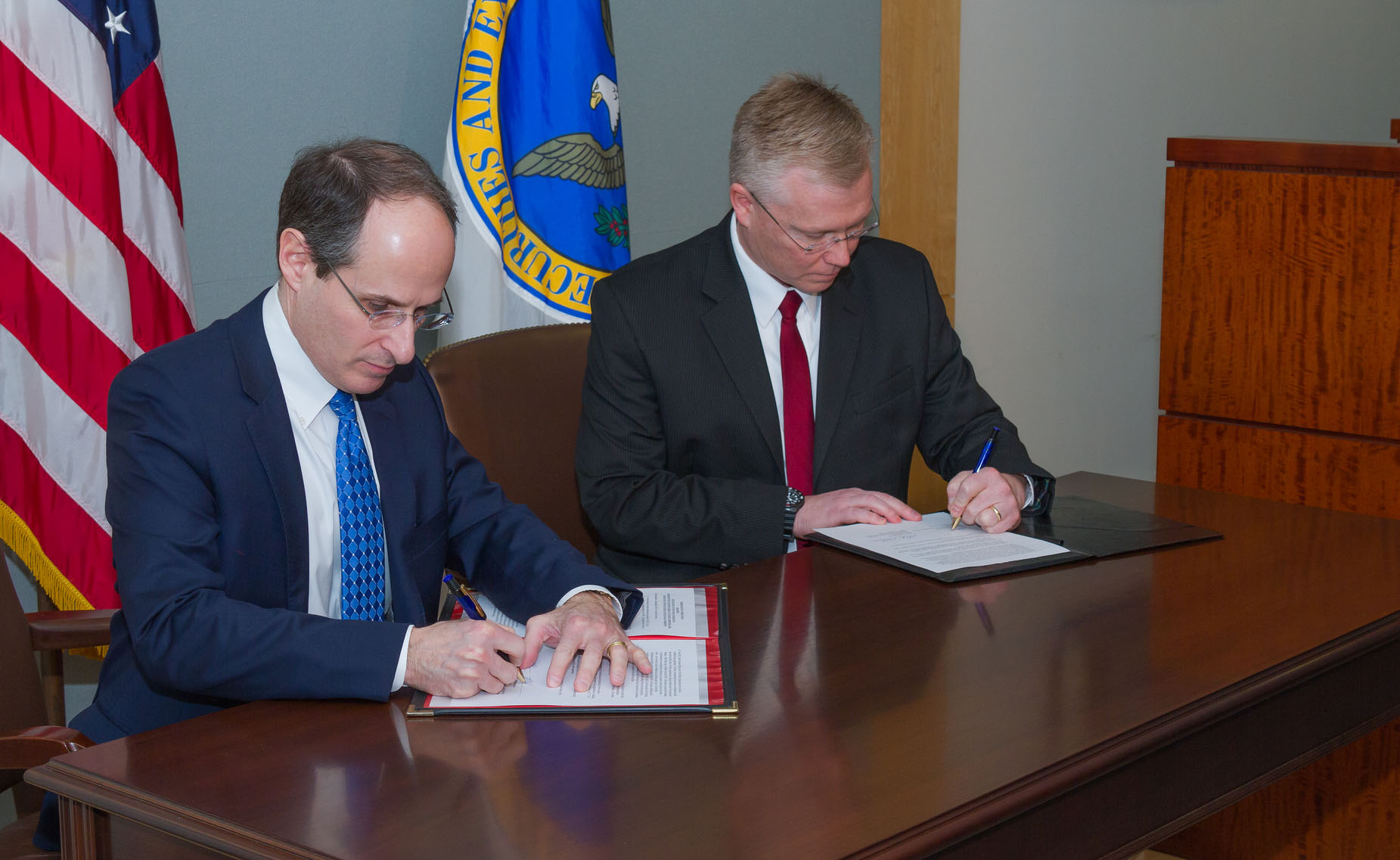
NASAA President Mike Rothman (L) and SEC Acting Chairman Michael Piwowar sign MOU.